


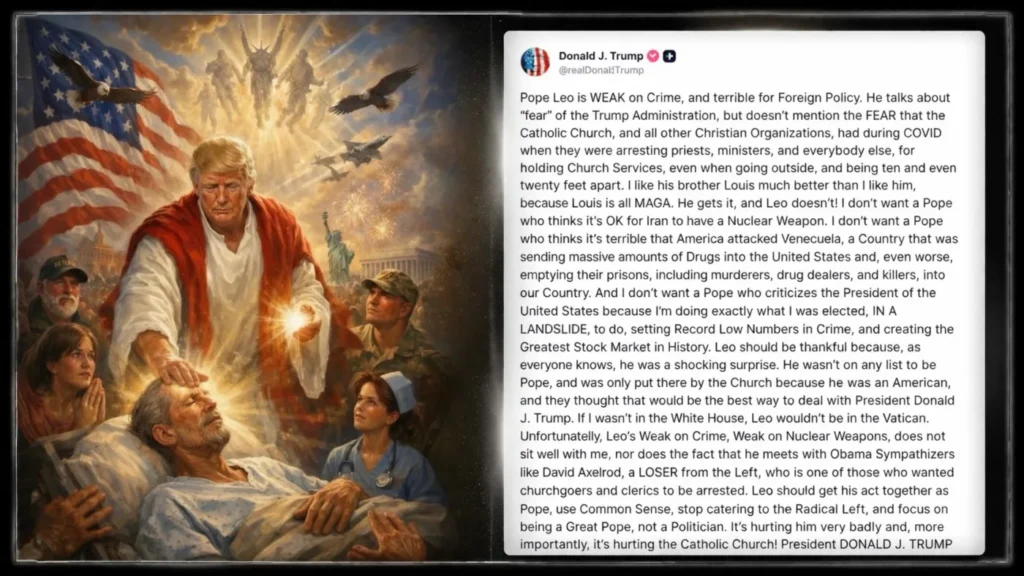
A clash between Donald Trump and Pope Francis reveals more than stylistic differences, highlighting how Trump’s abrasive communication overshadows substance.
Trump vs. Pope: When Form Kills Content
The conflict between Donald Trump and the Pope exposes more than just a difference in styles. It’s a collision between brutal politics and a moral narrative, though the latter isn’t free from political entanglements. The core issue is that form has once again killed content.
Style vs. Content – Why Trump Fails to Communicate
Trump is a phenomenon that defies sensible analysis, and considering him mentally ill – as many observers insist – feels unsound. Dozens of American psychiatrists signed a letter suggesting this during his first term, despite lacking the ability to conduct a clinical examination, making it politically motivated and self-compromising. However, Trump’s communication style exhibits a self-destructive tendency, choosing words that provoke dislike and outrage, even when his policies are reasonable or acceptable.
Had the conversation between the President and the Pope been conducted in a civilized manner, the Pope’s position wouldn’t be as strong. However, Trump’s choice of phrasing ensures that the core issue is obscured by an unacceptable form.
Vatican on Ukraine: A Return to Controversy
To understand this, one must recall the time when the Vatican, under Francis, attempted to navigate a symmetrical narrative regarding Russian aggression in Ukraine. The 13th Station of the Cross at the Colosseum on April 15, 2022, is a stark example. The Pope’s concept involved a Russian and a Ukrainian woman carrying the cross, seemingly equating suffering and guilt in the war. The final statement mentioned rebuilding what “bombs wanted to destroy,” as if bombs acted independently and were solely responsible for death and destruction.
Aftermath and Criticisms
Following criticism, including from Ukrainian Greek Catholic Church representatives, the Pope abandoned that reflection, replacing it with a call for silent prayer for peace. However, Francis consistently avoided naming Russia and Putin as the aggressors, with his Secretary of State, Cardinal Parolin, even admonishing Ukrainians to avoid “escalation” and criticizing countries aiding Ukraine – including Poland – for lacking moral justification.
Parolin even stated that a proportional armed response, as taught by the Catholic Church’s Catechism, could expand the conflict with catastrophic consequences. Those who heard these statements during the war’s critical phase, when Kyiv’s fate hung in the balance, were horrified, and believers experienced genuine pain. This was fueled by the realization that the motivation wasn’t evangelical, despite the lofty language and references to the Catechism, but rather a desire to maintain communication with the Russian Orthodox Church, which openly supported the war – a dialogue that yielded no positive results.
Similarities with Pope Leo’s Approach
Pope Leo’s stance is similarly nuanced. Notably, while Iranian authorities massacred tens of thousands of protestors, he offered only a general expression of concern. During the Angelus prayer on January 11, 2026, he stated, “My thoughts turn to the events currently unfolding in the Middle East, especially in Iran and Syria, where ongoing tensions continue to claim many lives.” This style echoes Francis’s 13th Station, attributing evil to vague “bombs” or “tensions” rather than specific actors.
The contrast between this approach to organized massacres and his more decisive stance towards Donald Trump’s words is striking. The Pope was far bolder and clearer regarding the US President, likely due to personal and political reasons – Leo, an American from Chicago, leans towards the Democratic worldview. Following this verbal clash, the Pope visited Algeria, a country culturally closer to Iran than the United States, and criticizing Trump likely aided his visit to North Africa.
Iran and the Politics of Peace: Does Neutrality Make Sense?
People of faith should strive for peace, a clear message from the Gospel, and Leo rightly calls for it. However, not all peace is meaningful. Appealing for peace without considering political realities is unproductive. This was the case with Pope Francis and the war in Ukraine. In Iran, we face a criminal regime that has persecuted its own people for decades, supported international terrorism, and armed itself heavily, as evidenced by the ongoing difficulty in fully destroying its ballistic missile capabilities, with a range even greater than declared, reaching Europe.
Furthermore, this regime was on the verge of producing nuclear weapons. In this situation, destroying Iran’s missile and nuclear resources, and creating conditions for regime change, is a sensible and far-sighted action. Calling for peace sounds unconvincing. If presented this way, a conversation with Pope Leo would be more meaningful. However, Trump’s crude statements have inflamed public opinion, making it harder, if not impossible, to defend an otherwise legitimate cause.