


US launches extensive Iran airstrike demanding regime change, raising legal and political questions about decision-making process.
The Operation and Its Scope
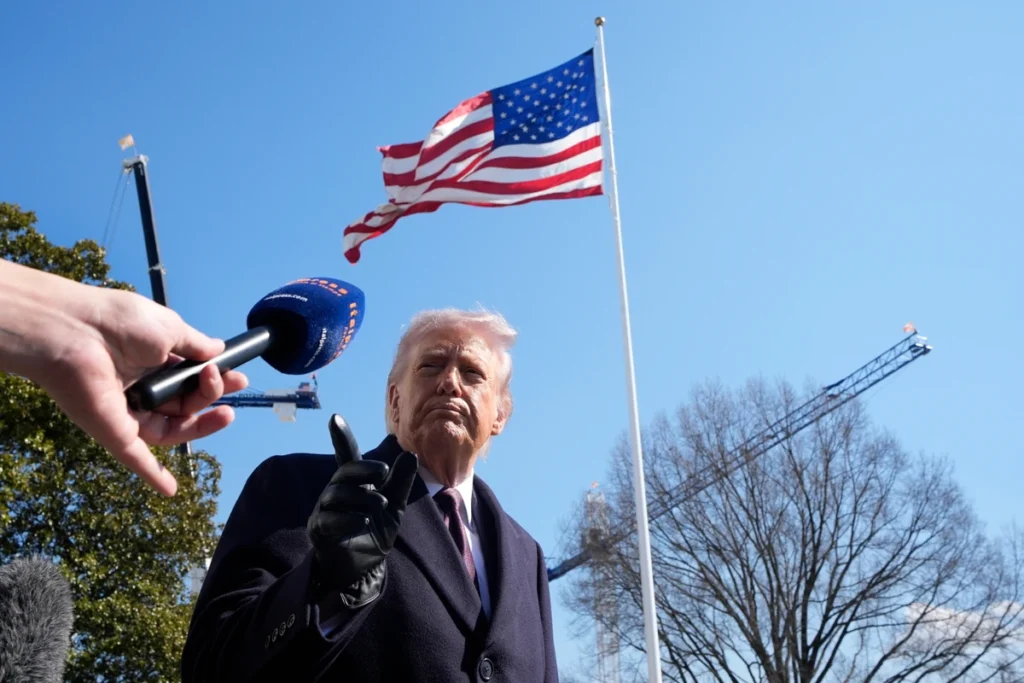
In an eight-minute speech following the start of airstrikes, Donald Trump left no doubt that the operation is not symbolic or limited. He demanded the surrender of Iran’s Islamic Revolutionary Guard Corps (IRGC), threatening to destroy its structures, missile arsenal, and navy. At the same time, he called on “Persians, Kurds, Azerbaijanis, Balochis, and Arabs from Khuzestan” to revolt against the authorities in Tehran and “throw off the burden of tyranny”.
This scope of objectives goes far beyond a classic deterrent strike. In practice, it represents an attempt to force a regime change – without declaring the deployment of ground troops and without presenting a political plan for the period after a possible fall of power in Tehran.
Legal and Historical Parallels
From a legal perspective, the operation raises serious doubts. The United Nations Charter permits the use of force only in self-defense in case of a direct threat or based on a mandate from the UN Security Council. The Trump administration has not publicly presented evidence of a direct, imminent threat from Iran to US territory. Thus, the attack is seen as a violation of international law.
Comparisons to the 2003 invasion of Iraq arise naturally. At that time, the George W. Bush administration justified the intervention with the existence of weapons of mass destruction, which were never found. Today, the White House speaks of a threat from Iran’s nuclear program and Tehran’s missile potential.
The problem is that – as both inspectors from the International Atomic Energy Agency and some US intelligence services have indicated in recent years – no evidence has been presented that Iran has decided to build a nuclear weapon. Iranian authorities, with Supreme Leader Ayatollah Ali Khamenei at the helm, have repeatedly declared that they do not seek to construct an atomic bomb. Foreign Minister Abbas Araghchi reiterated just last week that Iran “will not create a nuclear weapon under any circumstances”.
Regional and International Implications
Israeli Prime Minister Benjamin Netanyahu announced that his country has joined the operation to “remove the existential threat from the terrorist regime in Iran”. Israel has long viewed Iran’s nuclear program and Tehran’s support for Hezbollah and other groups as a direct threat to its security.
The joint operation by the US and Israel significantly increases the scale of the conflict. For Tehran, this means war with two of its most important opponents simultaneously. For the region – the risk of operations spreading to Lebanon, Syria, Iraq, and Yemen.
The flashpoint remains the Strait of Hormuz, through which about 20% of the world’s oil trade flows. Attacks on tankers, drilling platforms, or warships could trigger a sharp rise in oil prices and global economic turbulence.
Domestic Political Context
Just ten days before the start of the war, Donald Trump inaugurated the activities of his Peace Council – a body that was to serve as an alternative forum for conflict resolution. Representatives from 27 countries, largely authoritarian, appeared in Washington and publicly praised the president as a mediator.
Today, this initiative appears as a paradox. The first war of the “Peace Council era” began without broad consultations with Congress, without public debate, and during diplomatic talks with Iran. Eighteen congressional leaders received classified information just hours before Secretary of State Marco Rubio’s speech. Some Democratic senators admitted that they were not presented with convincing arguments for the necessity of immediate intervention.
Polls show that only about 25% of the American electorate supports a new war in the Middle East. In the context of upcoming parliamentary elections, the political risk is enormous.