


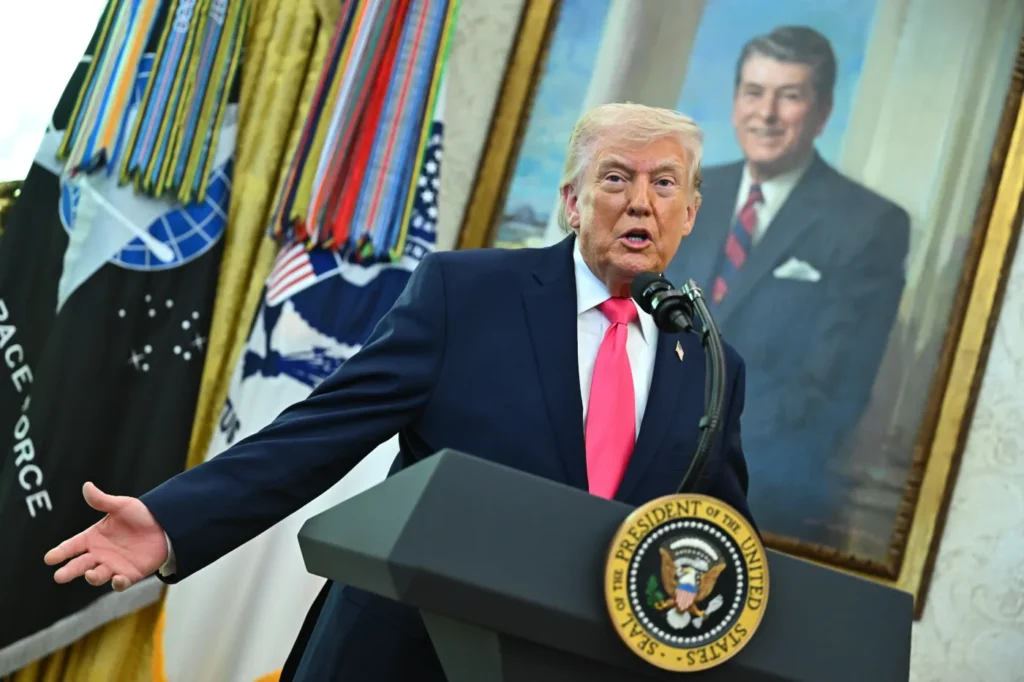
President Trump faces mounting challenges in his conflict with Iran, as initial promises of a swift victory give way to a prolonged and costly stalemate.
Trump’s War Without a Clear Path
Trump initiated a conflict he appears unable to win, while simultaneously considering new military engagements. He has recently indicated further potential targets.
Entering the second month of conflict with Iran, Trump’s administration is grappling with increasing inconsistencies. Initially, the White House projected a rapid, decisive victory, suggesting U.S.-Israeli strikes would cripple Iranian military capabilities and force concessions. This plan has not materialized as presented.
Strained Credibility and Economic Impact
The Strait of Hormuz remains a key point of leverage for Iran, and markets are reacting nervously to developments. Trump oscillates between triumphalism, threats, and claims of peace talks denied by Tehran.
This is no longer a story of “swift punitive action,” but a conflict damaging the credibility of the White House, Trump’s standing, and the global economy. Trump, who built his political image on being a decisive negotiator, has become a prisoner of his own narrative.
Trump’s Megalomania as a Political Tool
In this war, Trump’s words are as important as military actions. He consistently employs a language of extreme confidence, using exaggerated promises in place of a concrete strategy.
Trump has publicly declared resounding successes, suggesting American strikes virtually eliminated Iranian military capabilities, and rated his own performance “15 out of 10.” This style is central to his political approach: creating reality through communication, even when events contradict it.
This megalomania has evolved from a personality trait into an operational problem. Trump alternates between claiming total destruction of the enemy and seeking assistance from allies, signaling weakness. He announces the war is going well while simultaneously issuing new ultimatums, demonstrating a loss of control.
Chaos and Distrust
This management style produces information chaos and erodes trust among partners and markets. The Associated Press described Trump’s recent statements as contradictory and confusing, while Reuters noted that after a month of war, the White House faces difficult choices: escalation or a face-saving exit.
Echoes of Past Promises
This situation mirrors Trump’s past promises. During his campaign, he claimed he could end the Russia-Ukraine war within 24 hours, a symbol of his political self-presentation as a leader who doesn’t need lengthy diplomatic processes. Reuters and AP later reported that upon returning to power, Trump toned down this pledge.
A similar pattern is emerging with Iran: initial suggestions of a quick resolution and total dominance, followed by increasingly nervous adjustments to the message after a month of war.
A War Without a Quick Finale
Trump’s biggest problem is that the war, presented as a swift offensive, has become politically bogged down. The conflict began on February 28, 2026, and the administration has repeatedly claimed the operation is effective and Iran has been severely defeated.
However, after a month, there has been no lasting opening of the Strait of Hormuz, no collapse of the Iranian power structure, and no unconditional acceptance of American peace terms. Reuters notes that while Trump signals a desire to de-escalate, key objectives remain unmet or ill-defined.
This highlights the gap between rhetoric and reality. The White House built an image of near-total dominance, with Karoline Leavitt speaking of thousands of targets hit and Trump threatening “hell” if Iran doesn’t concede military defeat.
If the enemy were truly defeated, constant threats would be unnecessary. Washington’s language suggests that military pressure has not yielded the expected political results, leading Trump and his team to repeat the claim that Iran is on its knees while simultaneously threatening further action.
Narrative Failure at the Strait of Hormuz
The situation at the Strait of Hormuz most clearly exposes the weakness of the American narrative. This narrow strait handles about 20% of global oil and gas transport. When Iran blocked or significantly restricted traffic, the war became a global energy crisis.
Reuters reports that Brent crude prices have risen by over 50% since the start of the conflict, at times exceeding $119 a barrel. Analysts suggest prices could even reach $200 if Iranian export infrastructure is damaged. Approximately 11 million barrels of daily supply have been removed from the market, a scale that cannot be masked by propaganda.
Trump attempted to portray the situation as if pressure on Iran would quickly force concessions. However, the waterway has not been simply reopened. American announcements of escorting tankers proved premature, delayed, or conditional on military readiness. When a superpower threatens to impose its will within 48 hours, then postpones deadlines and suspends ultimatums, the market interprets this as uncertainty.
Global Economic Repercussions
The war with Iran is now a full-fledged economic shock. Reuters estimates that Brent could average $134.62 if current conditions persist, with forecasts rising further if the conflict expands. This means inflationary pressure, increased transportation costs, and impacts on the chemical, agricultural, and logistics industries.
Financial market signals are equally telling. On March 27, the Dow Jones entered a correction, falling over 10% from its recent peak, while the S&P 500 and Nasdaq reached six-month lows. Brent reached $111.68, and investors are increasingly discounting not only the war itself but also the loss of faith in the coherence of White House policy.
Peace Talks Without Tehran’s Confirmation
A key feature of the current phase of the conflict is the discrepancy between Trump’s statements and Iran’s acknowledgements. Trump repeatedly asserted that Iranians want an agreement, that talks are underway, and that intermediaries are working on a plan. Reuters confirms the existence of a 15-point American proposal delivered through Pakistan, covering nuclear disarmament, missile restrictions, and the issue of Hormuz.
However, from Tehran’s perspective, this does not look like a near-agreement, but a list of conditions largely favoring the U.S. and Israel. Crucially, Iran publicly denies Trump’s narrative of ongoing negotiations, dismissing claims of “very good and productive” contacts as psychological pressure and market manipulation.
Trump’s Pursuit of a Nobel Peace Prize
Trump has long sought to be seen as deserving of the Nobel Peace Prize, repeatedly speaking of feeling undervalued in this regard. Earlier in 2026, he even accepted a symbolic Nobel medal from Maria Corina Machado, reinforcing his image as a politician craving validation.
This trait is particularly relevant now, as Trump simultaneously wants to be seen as a peacemaker and a leader willing to “unleash hell.” These two roles are difficult to reconcile.
Allies Weary of Trump and His War
The war with Iran has also revealed that Trump has not only failed to convince Iran to surrender but also cannot maintain a broad front of Western allies around his strategy. Reuters and the Washington Post reported his increasingly sharp attacks on NATO and complaints about European countries refusing material or military support.
Trump even questioned the purpose of American presence in the alliance, suggesting that if partners don’t help him, the U.S. “doesn’t have to be there for them.” This war, intended to demonstrate American strength, has undermined trust in U.S. leadership within the Western system.
American Public Opinion Shifts
The numbers are concerning for the White House. Reuters reported Trump’s approval rating falling to 36%. AP-NORC found that 59% of Americans believe U.S. military actions against Iran have gone too far, while only 35% support Trump’s handling of the situation. About six in ten oppose sending ground troops.
This indicates that Trump has not convinced a majority of the public, either morally or pragmatically. Citizens may support blocking Iran’s nuclear program but do not want an endless war, expensive gasoline, and the risk of new casualties.