


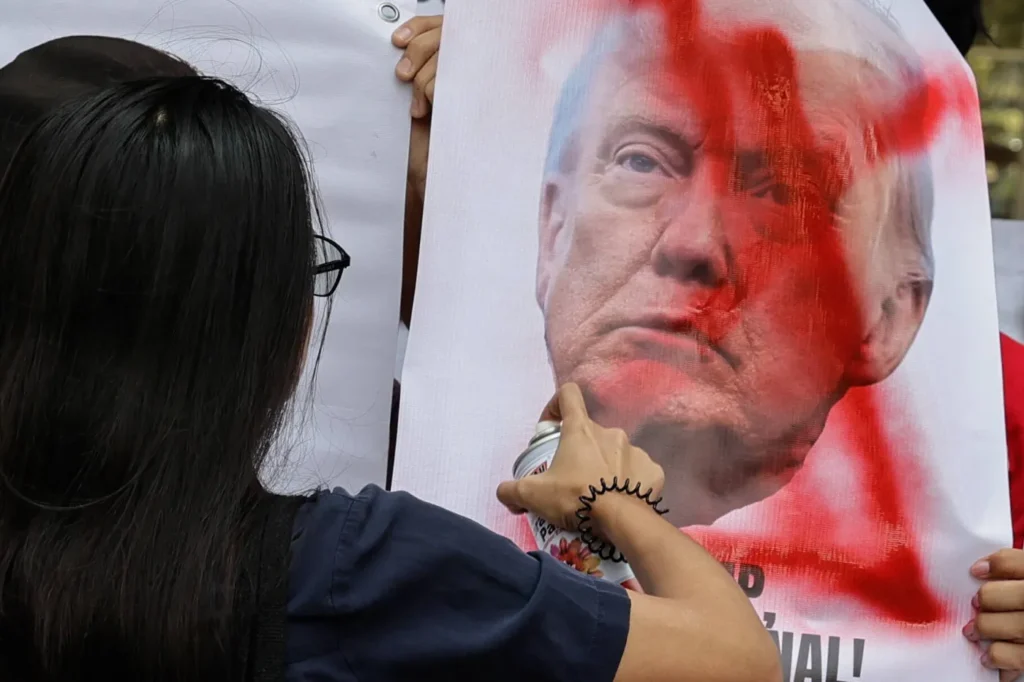
Donald Trump’s presidency is navigating a period of intense political and economic challenges, marked by declining approval ratings and international tensions.
Political Crisis Deepens
Recent weeks of political crises, international tensions, and internal disputes have placed Donald Trump’s presidency in a difficult position, according to the British publication, The Guardian.
Declining public support, controversial decisions, and growing pressure from both opponents and former allies indicate clear fractures within his political base.
Plummeting Approval Ratings
Recent public opinion polls show a significant decline in trust in the president. A Quinnipiac University poll indicates only 38% of voters view Donald Trump’s performance favorably, while 55% express a negative opinion.
Ratings regarding foreign policy are even worse – only 36% of respondents approve of his actions towards Iran, while 58% disapprove.
Economic Concerns Grow
Data concerning the economy is particularly worrying for the administration. Two-thirds of those surveyed blame the president for rising fuel prices, a key indicator of social discontent in American politics.
Rising living costs are beginning to impact voter groups that previously formed the foundation of Trump’s support.
Disappointment Among Supporters
Increasingly, voices of disappointment are emerging among his own voters, The British Guardian notes. Expectations regarding lower prices and reduced military engagement have not been met, leading to erosion of trust in key segments of the electorate.
Iran Conflict as a Turning Point
The decision to initiate military action against Iran in late February 2026 proved to be one of the most controversial moves of this administration. The conflict, conducted with the involvement of Israel, did not yield a quick resolution, and its consequences began to be felt globally.
Iran not only was not decisively weakened but – according to analyses from institutions such as the Brookings Institution – strengthened its position in the region and maintained its nuclear ambitions. Simultaneously, tensions in the Strait of Hormuz caused oil prices to rise, directly impacting the economic situation in the United States.
Conservative Criticism of Iran Policy
Criticism of the decision also appears within conservative circles. Some commentators associated with the “America First” movement point out that military action contradicts Trump’s earlier declarations of avoiding foreign conflicts.
Conflict with the Church and Religious Reaction
Additional tension arose from the president’s statements regarding Pope Leo XIV, the first pope born in the United States. Trump publicly criticized the pope, describing him as “weak on crime and disastrous in foreign policy.”
The reaction from Catholic circles was immediate and decisive. Criticism came not only from liberal clergy but also from conservative bishops who had previously supported the president.
Controversy was further deepened by the publication on social media of an image generated by artificial intelligence, depicting Trump as a figure resembling Jesus Christ. The material was considered blasphemous and provoked outrage, even among his former evangelical supporters.
Legal and Image Problems for the Administration
The president’s situation is also influenced by events on the legal front. A federal court dismissed his lawsuit against The Wall Street Journal regarding publications related to Jeffrey Epstein. The judge ruled that Trump did not meet the legal requirements necessary to prove defamation of a public figure.
This is another example of growing image problems that weaken his position both domestically and internationally. Legal cases, even if they do not result in convictions, maintain negative media coverage and influence public perception.
International Failures and Loss of Influence
A significant blow to Trump’s image was also the situation in Hungary. Support given by his administration to Prime Minister Viktor Orbán did not yield the expected result – his rival, Péter Magyar, won the elections.
Commentators, including Anne Applebaum in “The Atlantic”, point out that Orbán’s defeat undermines the narrative of the inevitability of success for populist movements inspired by Trump. This could have long-term consequences for the global network of political alliances built by his administration.
Inflation and Economic Pressure as Key Challenges
One of the most serious problems remains the economic situation. Rising fuel prices and projected food price increases could further exacerbate social discontent in the coming months.
Experts indicate that the conflict with Iran has a direct impact on global commodity markets, and its effects will be felt in the long term. Agricultural sectors, dependent on access to fertilizers and stable energy prices, may be particularly affected.
Cracks in Trump’s Political Coalition
A breakdown of the broad coalition that enabled Trump’s return to power in 2024 is becoming increasingly visible. Discontent is growing among religious voters, in anti-interventionist circles, and among entrepreneurs affected by inflation.
Political commentators note that for the first time in years, real signs of weakening of the MAGA movement are appearing. Some of its former opinion leaders are beginning to distance themselves from the president’s actions, which could be crucial in the context of future congressional elections.
Risk of Political Destabilization Before Elections
The president’s low ratings raise concerns within the Republican Party about losing the majority in Congress during the by-elections. Such a scenario would significantly limit the administration’s legislative capabilities and increase the number of parliamentary investigations.
Experts emphasize that in a situation of growing political pressure, Trump may make increasingly unpredictable decisions. The inability to run for another term further changes the dynamics of his actions, limiting traditional mechanisms of political accountability.