


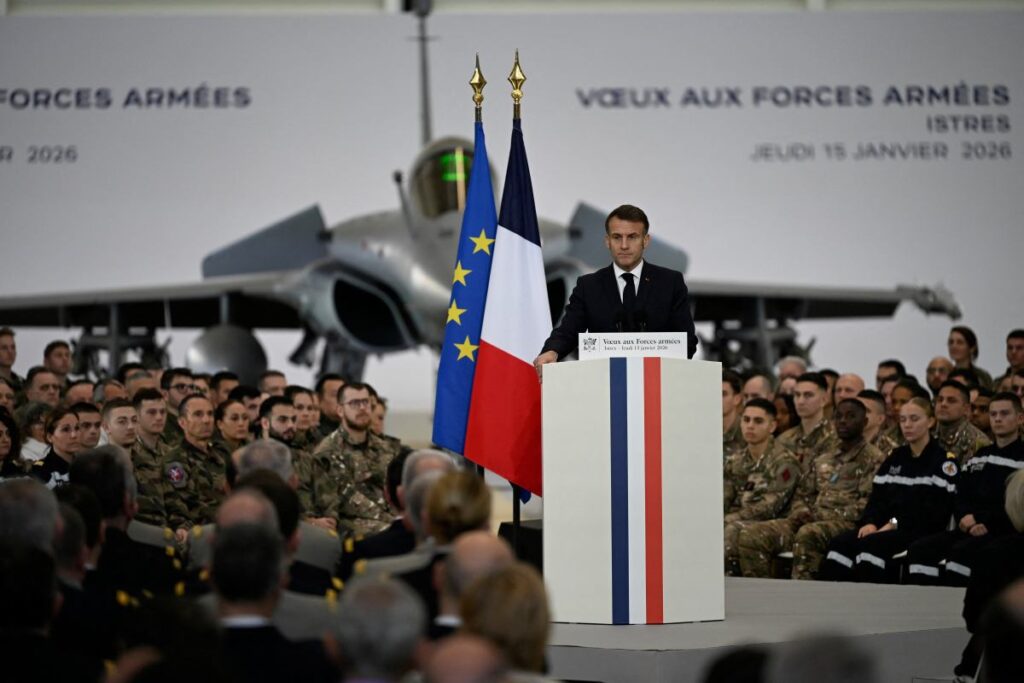
France has reportedly become Ukraine’s primary intelligence provider amid declining trust in US services, though rumors of a NATO breakup are unfounded.
Intelligence Cooperation Dynamics
Most importantly, we can learn about this. The nature of intelligence services is inherently secretive and avoids publicity. However, the past few months, especially the last week, have seen several high-profile reports about the state of intelligence cooperation among NATO countries.
This includes not just unofficial media leaks but also official statements that reveal the complex dynamics of transatlantic intelligence sharing.
The French Declaration
On January 15, French President Emmanuel Macron made an official announcement during a New Year’s address to troops at the Istres air base. He stated that France has replaced the United States over the past year as Ukraine’s primary intelligence provider, claiming that “2/3 of information is now being provided by France.”
According to the French president, his country supports Ukraine not just with data but also with planning and coordination of front-line operations. This represents a drastic change following Donald Trump’s assumption of office, as the US had previously been Ukraine’s critical and most important intelligence partner.
US Intelligence Suspension
A possible impetus for France’s increased role came in March 2025 when the US, on presidential orders, suspended intelligence sharing with Ukraine for about a week. This appeared to be pressure on Kyiv during the first round of talks to potentially end the war.
The US services had previously been Ukraine’s critical and absolutely most important partner, as Ukrainians themselves frequently acknowledged. The sudden suspension of cooperation must have been felt and likely encouraged greater diversification of intelligence sources.
Verifying Macron’s Claims
The precision of Macron’s statements cannot be verified. The Ukrainian military portal “militarnyi.com” claims that from a Ukrainian military perspective, French capabilities in satellite reconnaissance are substantial but do not equal those of the US.
The portal quotes former military intelligence chief General Kiryllo Budanov describing the importance of American satellite data: “If we lose the information provided as aid, optical imagery would decrease by about 15-17 percent, while radar imagery would decrease by about 46 percent.”
Broader Strategic Interests
Macron did not specify satellite intelligence data but rather general intelligence. The essence of the problem is that his claims cannot be reliably verified. However, there is no doubt that reducing dependence on US services is certainly in the interest not only of Ukraine but all of Europe.
This interest is clearly evident in the statements made by the French president and other European leaders seeking to diversify intelligence sources and capabilities.
Subtle Signs and Fake News
Various unofficial reports have indicated problems in the decades-long, close cooperation between US and European intelligence services. In August, American CBS News reported that US services had received orders to increase the secrecy of information regarding peace negotiations between Ukraine and Russia, classifying it to the NOFORN level.
This excludes even the closest countries from the so-called “Five Eyes” alliance, which includes the US, UK, Canada, Australia, and New Zealand based on once-secret agreements dating back to 1946. The order was reportedly issued by controversial National Intelligence Director Tulsi Gabbard.
Additional Reports of Tensions
In September, reports emerged that the UK and Netherlands had suspended sharing intelligence with the US that could help Americans conduct air attacks on ships in the Caribbean Sea. These airstrikes were at least legally questionable, if not outright illegal under maritime and war law.
Last week, a statement attributed to former French intelligence officer Vincent Crouzet garnered wide attention. He reportedly claimed that in response to declining trust in Americans, Ukrainians decided to test them by providing false information and observing whether it reached the Russians.
Correction on Crouzet Statement
However, as Ukrainian “Kyiv Post” reported days later, this was false information. The statement was attributed to the French officer on platform X, but he never actually made these remarks. Crouzet had only stated that the sudden and unexpected suspension of intelligence cooperation in March undermined Ukrainian trust in Americans, leading them to partially restrict their information sharing with US intelligence.
No Divorce Occurred
From these fragments, it can be concluded that trust in US intelligence among European partners has likely decreased over the past year, while the desire for greater independence in this area has grown significantly. It cannot be denied that faith in the authenticity of the alliance with the US has been considerably damaged in the past year.
However, there are no specific indications of a breakdown in intelligence cooperation. Although certain limitations may have emerged, the continued high level of cooperation is evidenced by Ukraine’s campaign of attacks on Russian refineries that began in summer 2025.
US Intelligence Capabilities
According to the American “New York Times,” the CIA played a significant role in this campaign, helping Ukrainians plan strikes by identifying which elements of Russian refineries were relatively easiest to damage but hardest to replace or repair.
There is no denying that the potential of US intelligence services must be enormous. They are the best-funded and largest in the world, possessing the largest satellite constellation and access to information gathered by an entire fleet of specialized aircraft and electronic reconnaissance drones.
Their penetration of Russian intelligence is deep, as recent years have shown they even understand what happens at the Kremlin. While they have never shared all their knowledge with allies, cutting ties with them would be painful. Therefore, it remains to be hoped that this won’t happen, though strengthening European capabilities will continue.