


U.S. military buildup in the Middle East signals potential large-scale conflict as Trump administration prepares for Iran action.
Tanker Surge Indicates War Preparations
On February 18, enthusiasts tracking U.S. military aircraft transponders counted 46 tanker planes flying east from the U.S. Hundreds more are reportedly stationed at bases across the Middle East and Europe. Not all aircraft fly with transponders activated, making exact totals unclear.
The number of tankers is a critical indicator of U.S. war readiness. These aircraft are essential for sustained aerial campaigns, as modern fighters lack the range for extended missions over a vast country like Iran. Current deployments significantly outnumber those before the June 2025 strike on Iranian nuclear sites, suggesting Trump’s ambitions extend beyond a single night of attacks.
AWACS and Combat Aircraft Deploy East
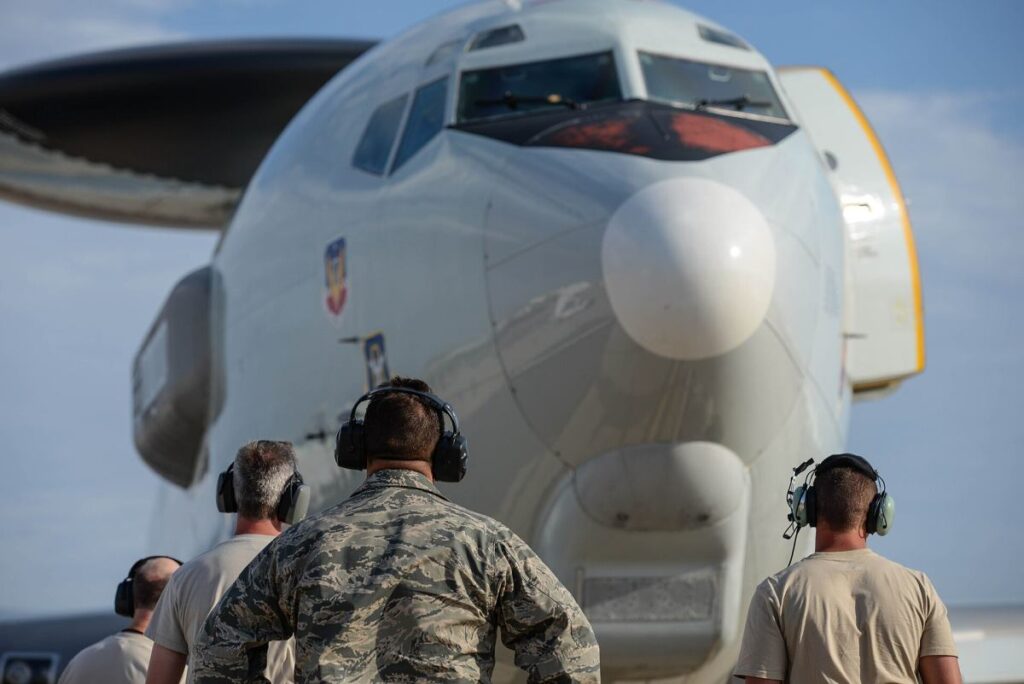
Not only tankers are moving toward Iran. Movements of E-3 Sentry (AWACS) airborne radar and command planes are highly significant. These “force multipliers,” alongside tankers, provide reconnaissance and coordination for smaller combat aircraft. Six E-3s departed the U.S. eastward in the last 48 hours, stopping in Germany and the U.K. before heading to Saudi Arabia—nearly a third of the active U.S. E-3 fleet. They were accompanied by two E-11 BACN communication aircraft; three others were already in Saudi Arabia. Electronic warfare planes were also spotted.
Combat Jets and Heavy Transport Intensify
Large tankers often escort several smaller combat aircraft on transcontinental flights, providing fuel and support. Combat jets typically fly with transponders off, limiting public tracking of their movements. Unofficial sources, satellite imagery, and aviation spotters report flights of various U.S. combat aircraft: F-35s from the U.K., F-22s from the U.S., F-15s and F-16s from Italy and the U.K. Axios reported roughly 50 combat aircraft were relocated to the Middle East in the last 24 hours, primarily to Jordan and Saudi Arabia. Approximately 130 F-15s, F-16s, F-22s, and F-35s are now in the theater, with more expected.
Heavy C-5 and C-17 transport aircraft are constantly active. Since early January, nearly 200 such flights have occurred, each carrying dozens of tons of cargo—ammunition, spare parts, personnel, maintenance equipment, and air defense systems. The scale of recent U.S. aviation movements is termed “extraordinary” by tracking enthusiasts.
Naval Reinforcements and Strategic Intent
One nuclear carrier strike group, led by the USS Abraham Lincoln (with ~90 aircraft, four destroyers, and likely a nuclear submarine), has been in the region since mid-January. The USS Gerald R. Ford, previously sent toward Venezuela last August, is now moving from the Caribbean toward the Middle East. Its transponder activated near Morocco on Wednesday; at a cruising speed of 20 knots, it could reach Israeli waters in under five days to bolster defense against potential Iranian retaliation.
U.S. preparations are highly visible, seemingly intended as a signal. While possibly aimed at pressuring Iran, leaks from U.S. and Israeli government circles suggest diplomatic solutions are deemed unlikely. Real war preparations, potentially involving a major campaign lasting weeks rather than a single night, are considered far more probable. However, final decisions remain unclear, and the achievable objectives with amassed forces are ambiguous.
War Likelihood and Objectives
According to Axios, the U.S. is much closer to war with Iran than apparent. Trump is reportedly frustrated by stalled negotiations and Iran’s intransigence. The recent Geneva talks yielded no results. Trump may order an attack within days, having previously aborted plans in mid-January due to insufficient military readiness. The U.S. military is now prepared, and the White House reportedly favors a large-scale campaign lasting weeks. Axios sources estimate a 90% probability of imminent conflict. Israel’s military and government also expect war within days and advocate for operations aimed at overthrowing the Ayatollah regime, though the feasibility of achieving this primarily through airstrikes is questioned.
The New York Times also noted Pentagon readiness for war, which could begin within days. Israel has been on heightened alert since mid-January with “significant” preparations. Belief in a diplomatic solution is minimal in Washington. Key uncertainty is the intended outcome of any strikes. The official goal remains destroying Iran’s nuclear program, despite Trump’s prior claims it was annihilated in June 2025.
Given Iran’s weakened air defenses and limited retaliatory missile capabilities from 2025, any new U.S.-Israeli attack could be one-sided. However, achieving concrete political objectives—forcing Iranian submission or regime collapse—through bombing alone is historically difficult, as shown by past failures to fundamentally alter the situation through such actions.