


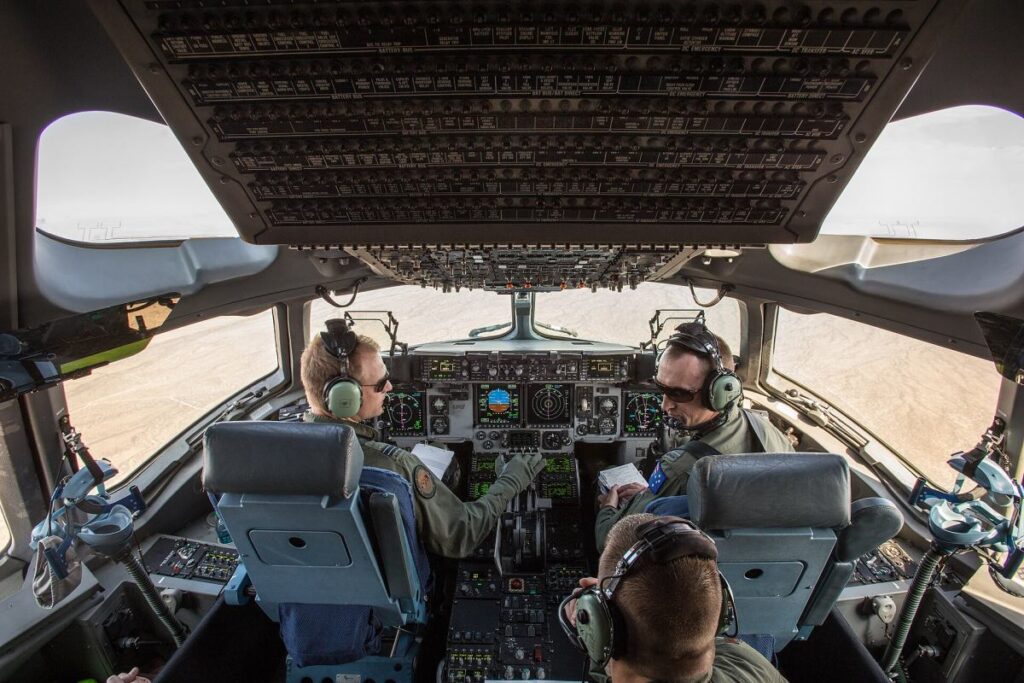
A U.S. C-17 transport plane, en route from Qatar to Crete, was abruptly recalled amid tensions, as President Trump declined to order strikes on Iran.
Military Movements and Flight Recalls
A C-17 Globemaster III, scheduled to depart around 21:00 Polish time from Al-Udeid base in Qatar for Chania, Crete, recalled its crew to the parking position, halting preparations. Earlier, six KC-135 aerial tankers had departed Al-Udeid. The base is the U.S. military position closest to Iran.
Pressure Tactics or Real Preparations?
These movements suggest a potential moment of escalation on Wednesday evening. The U.S. may have halted a developing airstrike or its preparations. This coincided with Trump’s 21:00 Polish time statement that killing in Iran had “stopped” and the U.S. did “not plan to hang anyone,” factors previously cited as justification for intervention. Iranian airspace was closed to civilian traffic from 23:15 Polish time for five hours.
Constraints on U.S. Military Options
The U.S. lacks visible signs of major force buildup in the region. There is no surge of tankers, radar aircraft, electronic warfare planes, or heavy transports from the U.S., nor observable redeployments of combat jets like F-22s or F-35s. The nearest aircraft carrier is in the South China Sea, about two weeks away. A significant airstrike campaign or Venezuelan-style raids appear unlikely without substantial preparation.
Under Iranian Pressure, Trump Faces Dilemma
Iran faces intense pressure due to its ruined economy and devastation of its military and proxy networks over the past two years. While threats of airstrikes, potentially targeting nuclear or missile programs, exert pressure, Trump reportedly demands a “quick and decisive” operation. However, Pentagon officials struggle to replicate the Venezuela Maduro capture scenario or achieve clear objectives like regime support for street protests.