


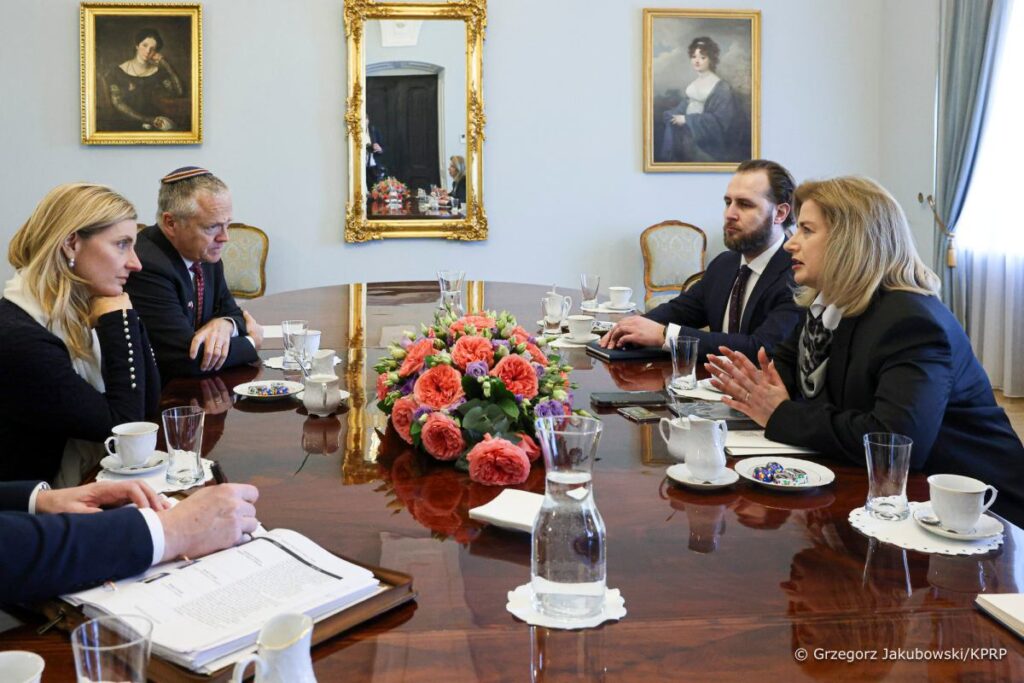
US Ambassador Tom Rose’s vehicle was seen at the Presidential Palace two hours before a National Security Council meeting sparked controversy.
Car Sighting Sparks Political Reactions
On Wednesday (February 11), TVN24 journalist Artur Molęda posted a photo on social media showing a vehicle leaving the Presidential Palace. Molęda noted it belonged to the US Ambassador and was observed two hours before the National Security Council (RBN) meeting, where Włodzimierz Czarzasty was to be discussed. Ambassador Tom Rose has recently clashed with the Marshal of the Sejm.
The photo caused significant debate. Łukasz Michnik, spokesperson for Lewica, commented: “Instructions arrived. I wonder if the US ambassador also brought some files for the president…” Vice-Marshal of the Senate Magdalena Biejat stated: “First, the ambassador decides which constitutional organs the US will engage with in Poland, and now what? Ensuring American interests are secured at the RBN? The motto of PiS and the president should be: On your knees and to America.”
Journalist Dominika Długosz responded: “Basic facts: what? a car, whose car? the ambassador’s, what did the car do? entered, when did the car enter? Two hours before the RBN. But this immediate explanation is understandable.”
Presidential Chancellery Clarifies Visit
The Chancellery of the President of RP issued a statement. “During a visit to Poland today at the Chancellery of the President of RP, a meeting took place between Undersecretary of State Agnieszka Jędrzak and Sarah B. Rogers, Undersecretary of State in the US administration responsible for public diplomacy. The US Ambassador Tom Rose also participated. The meeting concerned cooperation on projects related to memory policy, for which Agnieszka Jędrzak is responsible at the Chancellery,” announced Rafał Leśkiewicz, spokesperson for Karol Nawrocki.
“I especially recommend to journalist Artur Molęda, who is looking for sensation where there is none. All it took was to ask,” Leśkiewicz added. Marcin Przydacz also shared similar information, stating: “It’s worth checking basic facts before starting to spin theories and spread disinformation. That’s what journalism is about.” He also responded to Dominika Długosz: “Basic facts: who? Ms. Dominika Długosz? For whom does she work? for media partly owned by Germans. What does she do? She writes critical materials about the Polish President. When? At various times, including during German-Polish tensions. Facts, truth? Nice?”
Paweł Szefernaker, head of the President’s Cabinet, addressed Magdalena Biejat: “Don’t embarrass yourself.” It emerged Sarah B. Rogers met not only with the president’s staff. “Secretary of State at the Ministry of Digitization Dariusz Standerski met with Sarah B. Rogers, Undersecretary of State in the US administration for public diplomacy. Talks covered support for innovation and digital economy development, cooperation in the security area, and the importance of cohesive and uniform regulations in the European Union,” reported the Ministry of Digitization.
Profile of Sarah B. Rogers
Since October last year, Sarah B. Rogers has been Undersecretary of State for Public Diplomacy. This is one of the most important positions in US diplomacy, created to strengthen relations between the United States and the public in other countries (as opposed to traditional diplomacy directed at governments). She is an experienced lawyer and, as described by the US Department of State, “an activist for freedom of speech.”
According to “The Guardian,” Rogers has become “the face of the growing hostility of the White House towards European liberal democracies” and “actively supports right-wing movements on the continent.” She builds alliances with European right-wingers, including through direct meetings with politicians. She has met, for example, with representatives of Reform UK or Markus Frohnmaier, an MP for Alternative for Germany (AfD), who was accused of ties to Russia. Rogers is also very active on social media, where she amplifies messages from the far-right in Europe; in one post, she described immigrants in Germany as “a barbaric horde of rapists.” She has also spoken critically of the European Digital Services Act (DSA) and the UK’s Online Safety Act, calling them attempts to “expand censorship in Europe and worldwide.”
Report: US Funding for MAGA-Linked European Think Tanks
Meanwhile, “Financial Times” reports that the US Department of State is planning financial support for European think tanks and NGOs “linked to the MAGA movement.” According to the newspaper, Sarah B. Rogers traveled to Europe in December for this purpose, meeting key right-wing organizations. She is also said to have discussed with Reform UK politicians led by Nigel Farage regarding funding activities to “spread American values.”
Officially, this is connected to the 250th anniversary of US independence. The newspaper spoke with a British politician who attended a meeting with Rogers. The politician stated that the official “had a fund from the Department of State to carry out MAGA-style actions in various places” and wanted to finance organizations that could “undermine the actions of governments” in European countries. Professor Léonie de Jonge of the University of Tübingen, who studies far-right extremism, told “The Guardian”: “The Trump administration has a personal interest in strengthening anti-democratic movements abroad because it helps achieve its own plans and simultaneously legitimizes these entities and their actions.”