


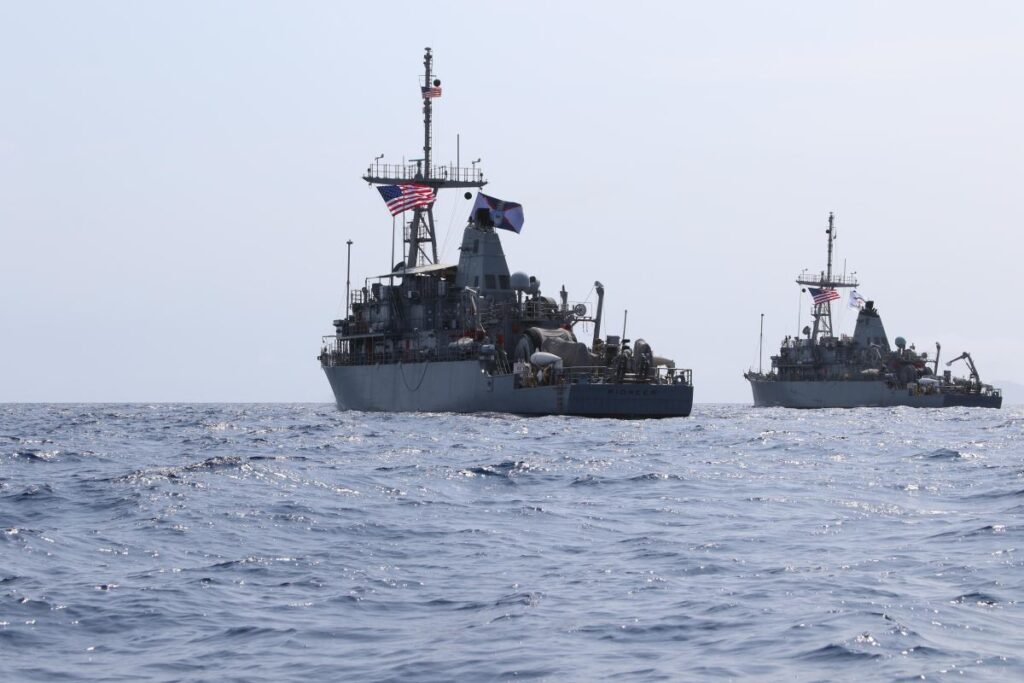
The US Navy is repositioning minesweepers and other assets to the Strait of Hormuz, utilizing a lull in conflict to assess and clear potential Iranian-laid mines.
Return to the Strait
Shipspotters, maritime enthusiasts who track vessel movements, have been instrumental in identifying US Navy deployments, particularly in the strategic Malacca Strait connecting the Indian and Pacific Oceans.
On April 8th and 10th, two Avenger-class mine countermeasures ships, USS Chief and USS Pioneer, were photographed during a two-day stop in Singapore before heading west towards the Indian Ocean and, likely, Iran.
Minesweeper Redeployment
These two vessels represent half of the US Navy’s dedicated mine countermeasures force. Four other Avenger-class ships were previously stationed in Bahrain to address potential threats in the Persian Gulf but were recently retired and returned to the US due to their age and condition.
Withdrawal of Littoral Combat Ships
During the escalation of tensions, three Independence-class littoral combat ships (LCS) were deployed to the Persian Gulf, ostensibly equipped with new mine-hunting technology. However, all three ships departed Bahrain just before the outbreak of hostilities.
Two were subsequently spotted by Malaysian shipspotters and docked in Singapore for an extended period, while the third reportedly relocated to the Diego Garcia base in the Indian Ocean—indicating a low assessment of their effectiveness in the conflict.
Challenges of Mine Warfare
Mine countermeasures operations require calm conditions, as specialized vessels are lightly armed and armored, making them vulnerable to attack. They also must operate slowly and cautiously to effectively utilize their equipment.
The US Navy evidently deemed the risk of operating in a contested environment too high during active conflict, but the current ceasefire provides an opportunity to address the potential threat.
Current Deployments and Force Build-up
The two Avenger-class ships are now en route to the Persian Gulf, and one of the Independence-class LCS has departed Singapore in early April, last reporting its position heading west towards the Indian Ocean—potentially reaching the Sea of Arabia and the Strait of Hormuz.
The US Navy is also utilizing drones and helicopters, launched from Oman, for preliminary mine detection. The Navy possesses 16 mine countermeasures companies equipped with drones, deployable via transport aircraft.
On April 11th, two Arleigh Burke-class destroyers transited the Strait of Hormuz, a move considered risky given their lack of dedicated mine countermeasures equipment, but seemingly undertaken with a degree of confidence regarding the current mine threat.
Future Operations and Regional Stability
A systematic sweep of the Strait of Hormuz using Avenger and Independence-class ships is anticipated, potentially restoring confidence among shipping companies and resuming normal traffic. However, maintaining the ceasefire is crucial.
The US has announced a naval blockade of Iran, which could prompt Iran to indirectly exert pressure by disrupting traffic in the Strait, potentially leading to limited naval clashes rather than full-scale war.
Further bolstering its presence, the US Navy is deploying the USS George W. Bush aircraft carrier strike group towards the Sea of Arabia, taking a longer route around Africa to avoid potential threats from Houthi forces in Yemen.