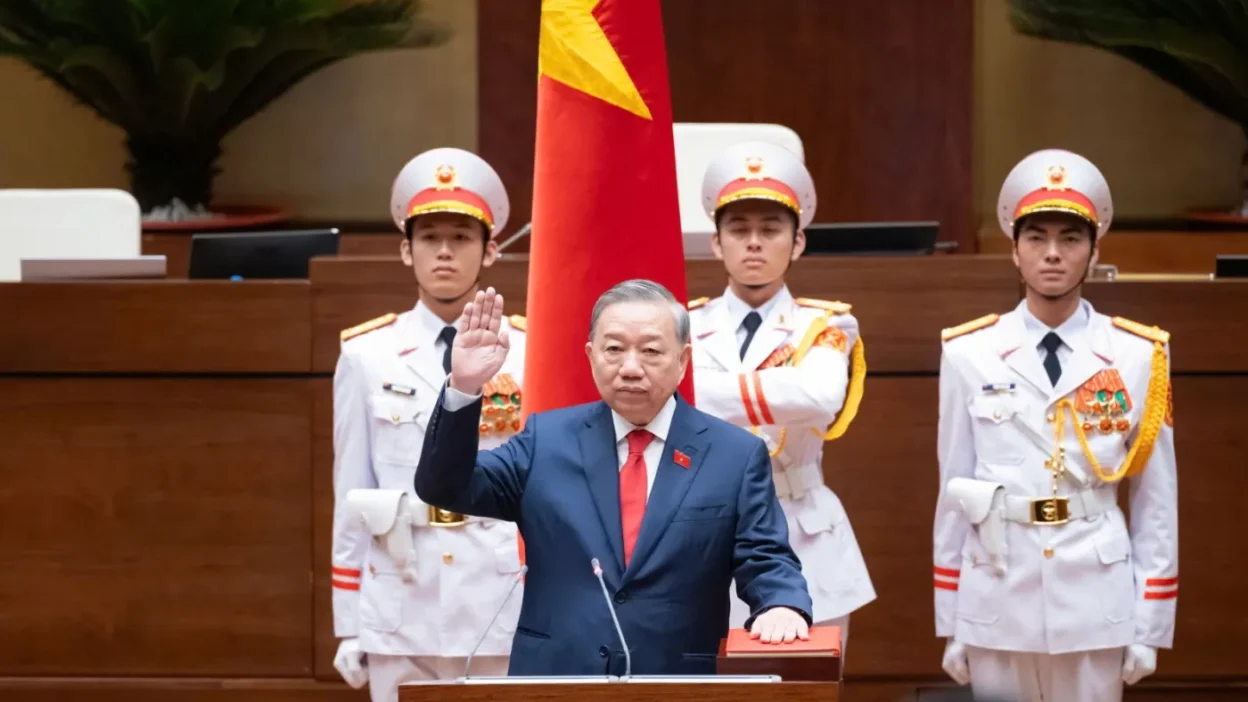
Vietnam’s parliament unanimously elected To Lam as president, prompting speculation about a move away from collective leadership and closer ties with Beijing.
To Lam Elected President, Centralizing Power
Vietnam’s parliament on Tuesday unanimously elected To Lam, the general secretary of the Communist Party, as the country’s president. Experts suggest this marks a departure from the previous model of collective governance and a concentration of power in a single leader, mirroring the Chinese system of government.
President Lam Outlines National Priorities
In his address to parliament, the newly appointed president, who secured a second term as head of the Communist Party of Vietnam (CPV) in January, outlined the nation’s key priorities. “Our goal is to improve living conditions so that everyone can benefit from the fruits of development,” the 68-year-old leader declared.
To Lam’s Political Career
To Lam built his political career as head of the Ministry of Public Security, leading a broad-ranging anti-corruption campaign. He was sworn in as president in May 2024 and simultaneously assumed the role of CPV general secretary following the death of Nguyen Phu Trong. He held both positions for over two months before resigning as president in October.
As party leader, he implemented extensive administrative and bureaucratic reforms, aiming to transform the economy. These reforms received a mixed reception due to widespread layoffs within the administration. He was re-elected as CPV general secretary in late January.
Risks and Potential Benefits of Centralization
Analysts indicate that while the centralization of power may accelerate reforms and economic growth – with authorities in Hanoi aiming for annual growth exceeding 10 percent – it also carries significant risks.
Vietnam-China Relations: A Delicate Balance
“The concentration of more power in the hands of To Lam could pose a threat to Vietnam’s political system, such as an increase in authoritarianism,” says Le Hong Hiep of the ISEAS Yusof Ishak Institute in Singapore.
Despite being viewed as a pro-business leader, his policy of supporting “national champions” raises concerns about cronyism, corruption, and the risk of speculative bubbles in the economy, according to Reuters. Internationally, the leader will also face the need to maintain a pragmatic “bamboo diplomacy,” skillfully balancing pressure from the United States and complex relations with neighboring China.