


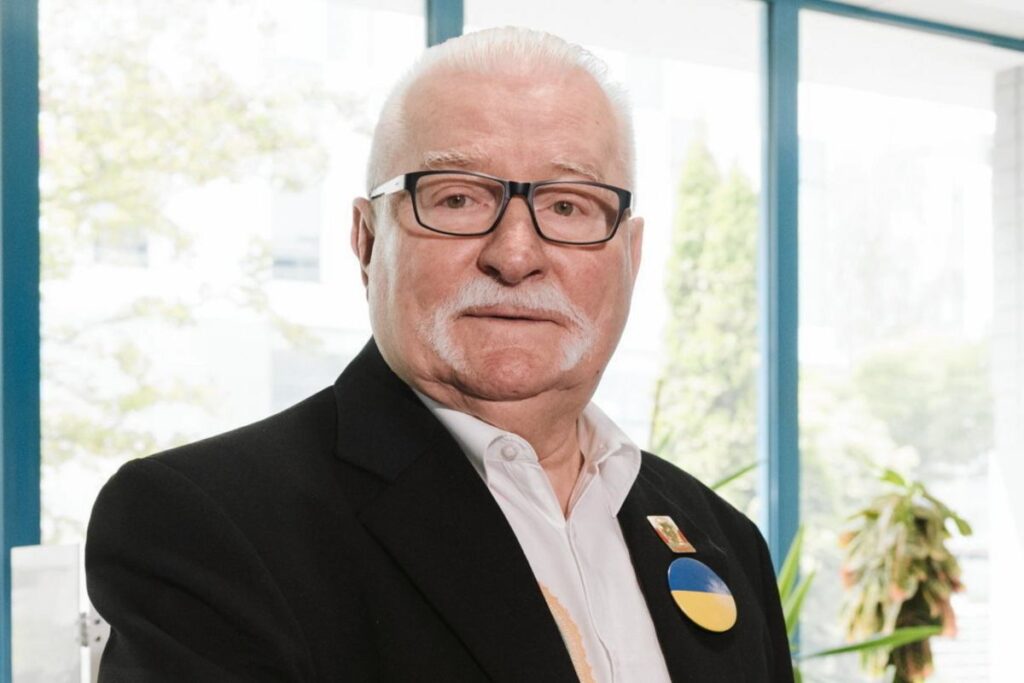
Former Polish President Lech Wałęsa has publicly removed his Ukrainian flag pin, citing outrage over President Volodymyr Zelensky’s decision to name a military unit after the Ukrainian Insurgent Army (UPA).
Wałęsa’s Withdrawal of Support
President Zelensky granted the “North” Special Operations Center the title “Heroes of the UPA,” justifying the move as a means to restore the historical traditions of the national army. Former Polish President Lech Wałęsa, who had consistently worn a Ukrainian pin since the start of the full-scale Russian invasion, responded by removing the emblem.
Wałęsa wrote on Facebook that Zelensky insulted him and the victims of the UPA by honoring “bandits.” While he pledged to continue supporting the Ukrainian people in their fight against the Soviets, he declared that he refuses to support Zelensky himself.
Ministry of Foreign Affairs and Official Polish Reaction
The Polish Ministry of Foreign Affairs condemned the move, with spokesperson Maciej Wewiór stating that the decision injures the memory of victims and threatens the dialogue between the two nations. The Ministry warned that the move could be exploited by Russian propaganda to undermine support for Ukraine.
The Polish Embassy in Kyiv reiterated that it consistently informs Ukrainian authorities that the UPA is viewed in Poland as a criminal organization responsible for war crimes. Reports suggest Deputy Foreign Minister Marcin Bosacki has met with Ukrainian Ambassador Vasyl Bodnar to formally express Warsaw’s opposition.
Presidential Office and IPN Criticism
Rafał Leśkiewicz, spokesperson for the Polish President, labeled the decision scandalous and incomprehensible, highlighting the UPA’s history of collaboration with Germany and the mass murder of Poles and Jews. The Institute of National Remembrance (IPN) joined the criticism, stating that the promotion of a UPA cult must be rejected by all who remember the organization’s actions.
Historical Context of the Volhynian Massacre
In July 1943, the UPA and the Organization of Ukrainian Nationalists carried out coordinated attacks on approximately 150 localities in the former Volhynian Voivodeship, resulting in the brutal murder of 80,000 to 120,000 Poles. While Poland classifies these events as genocide, Ukrainian public opinion remains divided, with many viewing the UPA primarily as an anti-Soviet independence movement.