


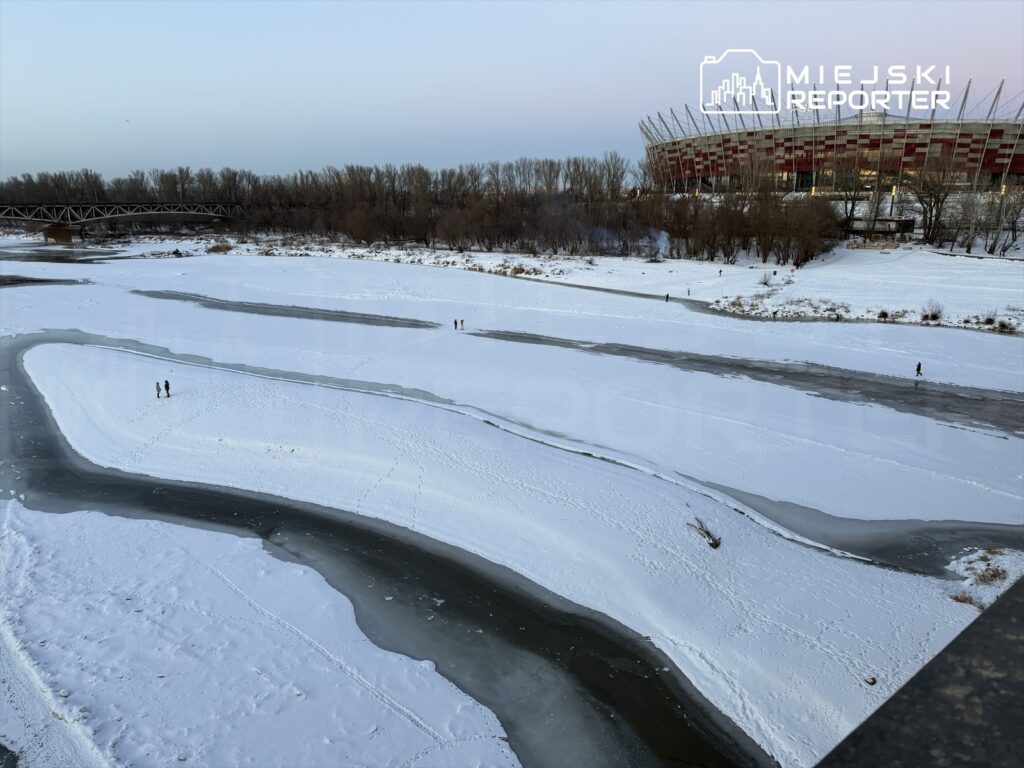
Pedestrians walking on the frozen Vistula River in Warsaw prompt warnings from emergency services, who emphasize that ice stability is unpredictable and poses lethal risks to both walkers and rescuers.
Pedestrians on the Ice
On Sunday, February 1, 2026, individuals were seen venturing onto the frozen river in the Warsaw section of the Vistula, particularly near the Poniatowski Bridge. Some daredevils walked toward sandy shoals beneath the bridge spans. Walking on river ice is extremely risky because the current remains active beneath the surface, and the ice on the Vistula can be uneven and collapse suddenly, even if it appears “solid” from the bank.
The Hidden Threat of the Current
While danger is real on frozen ponds, rivers add a critical factor: flowing water. The current undercuts the ice from below, weakening it invisibly. Rescuers note that ice cover on rivers can be thin and vary in thickness over very short distances; a few steps can take a person from a spot where the ice “holds” to an area with a polynya or a thin layer that will crack under human weight.
Treacherous Locations
Areas near bridges, channel narrowings, protruding shoals, islands, and spots where water accelerates or swirls are particularly treacherous. On these sections, ice is often “gnawed” from below and has lower load-bearing capacity. Furthermore, as firefighters describe, ice strength on flowing water can be significantly lower than on standing water, even if it looks similar to the naked eye.
Consequences of Falling In
The risk does not end with the ice breaking. The Vistula’s water temperature in winter is near zero, leading to rapid hypothermia. Services emphasize that minutes count in such conditions; a person loses strength quickly, experiences breathing and coordination problems, and self-extraction onto the slippery edge of the hole is often difficult.
Official Warnings and Patrols
This is why rescuers and law enforcement regularly appeal to the public not to venture onto the ice, even if the surface looks “calm” from the shore. In Warsaw, patrols are conducted in the Vistula area by the City Guard, which has been monitoring riverside sections in recent days specifically for people stepping onto the fragile ice.
Historical Context vs. Modern Reality
In the past, winters occurred where the Vistula in Warsaw froze sufficiently for crossing the river on foot to be practiced. However, historical realities—different scale of frosts and winter character—are no argument today for “testing” the river underfoot. Even if an ice sheet appears over a large area, it does not mean there is a stable, uniform cover across the entire width.
Rescue Procedures
If someone falls through the ice, the most important steps are to call for help and not to go onto the surface without security. Firefighters emphasize not running toward the victim; instead, one should crawl and attempt to extend a long object (scarf, branch, stick, sled). Above all, call 112 immediately. If the ice breaks under a person who has fallen in, recommendations are specific: stay on the surface, rest arms on the ice, try to “crawl” onto the shelf, then move away from the hole while lying down—crawling or rolling—preferably along the path taken to get there, and find warm shelter immediately.