


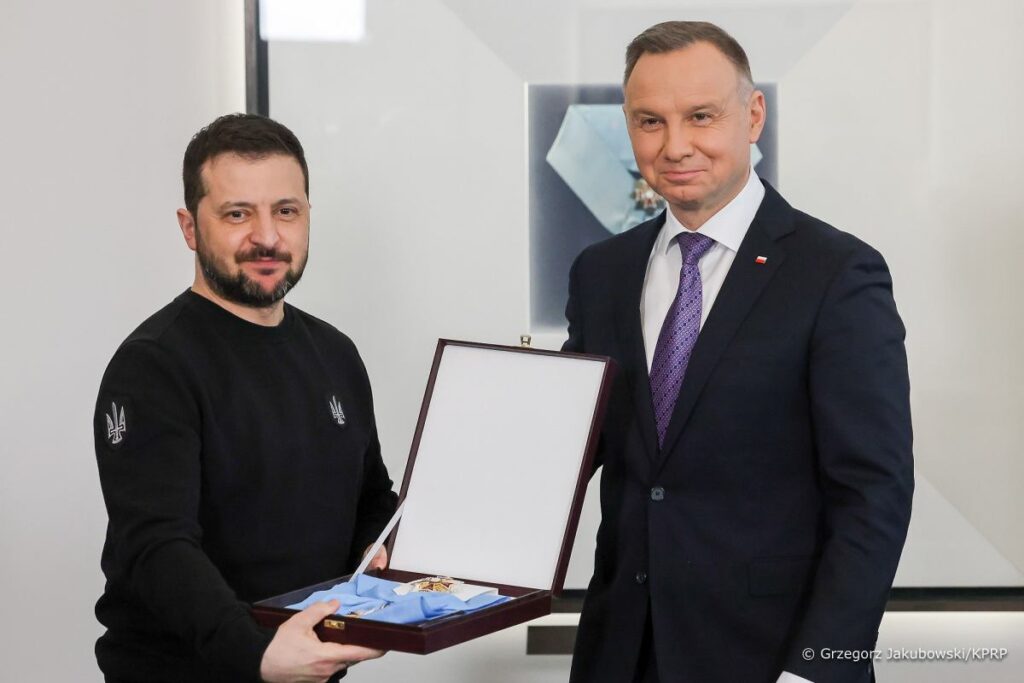
Following President Zelensky’s decision to name a military unit after the UPA, members of the Order of the White Eagle chapter are considering stripping the Ukrainian president of Poland’s highest honor.
The Controversy Over the UPA Name
Ukrainian President Volodymyr Zelensky officially named a unit of his country’s Armed Forces after the “Heroes of the UPA” on Wednesday, May 27. He stated the decision was intended to restore the historical traditions of the national army and to recognize the unit’s exemplary performance in defending Ukraine’s territorial integrity and independence.
President Karol Nawrocki criticized the move on Friday, May 29, stating that the decision proves Ukraine is not ready to join the European family due to its glorification of the Ukrainian Insurgent Army. He emphasized that the “European family” cannot permit the glorification of those who murdered women, children, and Polish citizens.
Potential Revocation of the State Honor
President Nawrocki announced that a meeting of the Order of the White Eagle Chapter is scheduled for June 8. He has proposed that the agenda include the potential stripping of the award from President Zelensky. While the final decision rests with the president, the chapter must convene to deliberate.
Prof. Michał Kleiber, Chancellor of the Order, noted that the chapter is so outraged that the meeting will likely result in the revocation of the award. He suggested that Zelensky’s decision was a misguided attempt to boost his low domestic popularity, noting that the Ukrainian public’s view of the UPA is often shaped by education that remains far from historical facts.
Historical Background and Previous Decoration
Volodymyr Zelensky was awarded the Order of the White Eagle in April 2023 by then-President Andrzej Duda for his contributions to Polish-Ukrainian relations and his defense of human rights. The Order is Poland’s oldest and most prestigious state honor, with its chapter standing guard over its integrity.
The conflict surrounding the UPA stems from July 1943, when the organization carried out coordinated attacks on approximately 150 villages inhabited by Poles in the Volhynia region. Poland views these events as genocide, while the Ukrainian narrative frequently frames them as part of a symmetric armed conflict, often highlighting the UPA’s anti-Soviet stance during the post-war period.