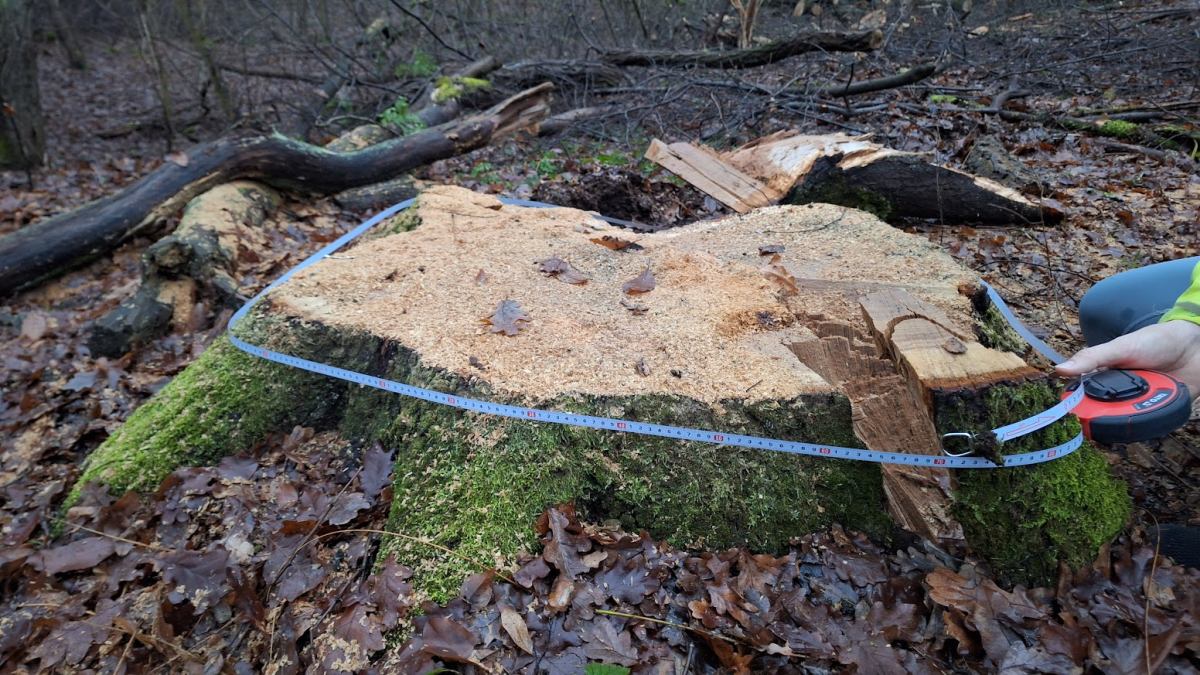
Activists report that over 30 old oak trees were cut down in Wrocław forests, despite bans on logging in protected areas.
Discovery of Logging
A friend discovered this by accident. He was running in the forest, specifically in a section that should be protected in multiple ways. He saw signs that two massive oaks had been cut down. So we started looking into this place, says Jakub Korczyński from The Climate Lab foundation.
It turned out that more than 30 old oaks were cut down there.
Mokrzany Forest
Activists first discovered the logging in Mokrzany Forest, located northwest of the city. This is the largest forest complex within the administrative boundaries of Wrocław, and its significance for residents is evidenced by the fact that a group fighting for forests around the capital of Lower Silesia is named after it – the Social Committee “Save Mokrzany Forest.”
In one of the forest divisions, activists found that about 30 oaks, aged 100 to 155 years, were cut down.
Logging Despite Bans
This division is fully exempt from timber harvesting under a moratorium announced by the Ministry of Climate and Environment in early 2024. Additionally, this fragment can be classified as so-called “old-growth forests,” and at the same time, it is part of urban social forests that should also receive special protection.
The scope of social forests around Wrocław was developed jointly by foresters and activists – and it’s worth noting – this compromise was presented as a positive example of cooperation between both sides.
“We were not informed about the planned actions, no consultations were carried out with the social side, and most of the harvested wood was removed, which – in our opinion – contradicts the approach adopted for this area in social forests,” write the activists.
Ratyński Forest
Later in the same forest district, a much larger scale of logging was detected in areas covered by the moratorium, social forests, and proposed old-growth forests. This concerns six divisions of Ratyński Forest, which lies south of Mokrzany.
Jakub Korczyński points out that so-called old-growth forests – which are to be a new category designated for protection – will be verified based on their current condition, age of trees, etc. – “And now there’s nothing left to verify there, because almost everything has been cut down,” he says.
Forestry Response
We asked the Miękinia Forest District and the Regional Directorate of State Forests (RDLP) about this logging. In the response sent to us, Malwina Sokołowska, press spokeswoman for the Wrocław RDLP, informs that the regional directorate knew about the ongoing works, but has now ordered a verification of their legality.
As Tomasz Międzyrzecki, deputy head of the Miękinia Forest District, wrote in response to our questions, the legal basis for the cuts was Article 9 of the Forest Act. According to it, foresters have the obligation to “maintain balance in forest ecosystems and increase the natural resistance of tree stands,” including preventing fires and the spread of pests.
The Forest Protection Team also issued an opinion. In its assessment, the tree stand in part of Mokrzany Forest, where oaks were cut down, “is severely damaged, and oak trees have been taken over by pests and fungi.” According to foresters, “failing to carry out sanitary cuts may result in significant damage caused by harmful factors.”
Social Forests
The regional directorate also addressed the agreement regarding social forests, which – as it emphasizes – “is a real and binding element of the forest management policy and is one of the key reference points for actions taken.” Foresters assure that the arrangements with the social side have “fundamental significance” and translate into specific decisions in planning forest work.
Social forests are one of the flagship projects of the Ministry of Climate and Environment. The goal is to change the functioning of forest management in forests around the largest cities, so that their social functions are treated as a priority, and timber harvesting has moved to the background.
Unplanned Logging
Each forest district in Poland operates on the basis of a 10-year Forest Management Plan. However, as activists report, in both forests near Wrocław, the cuts were carried out outside the plan – as so-called “accidental” (emergency) cuts.
Such work raises great concerns among groups fighting for forest protection, as it significantly hinders the monitoring of forest district activities. Therefore, “it requires special transparency and supervision by institutions responsible for implementing the moratorium and social forest arrangements,” write the activists.