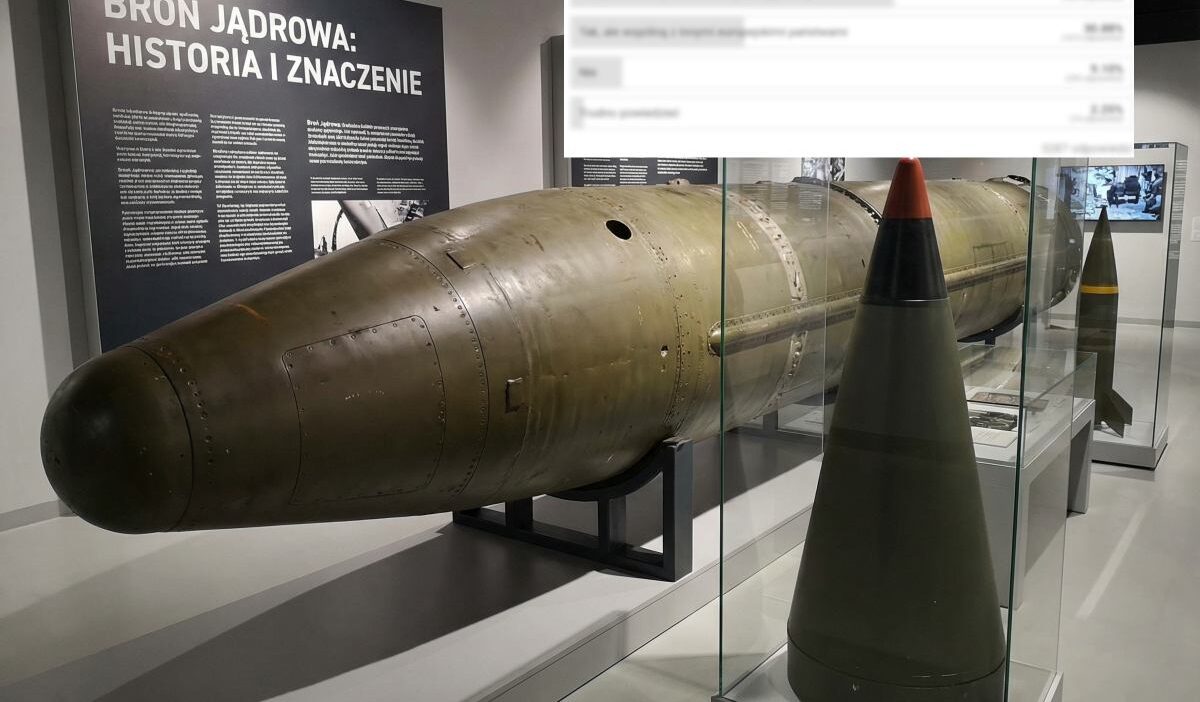
A survey reveals 57.77% of Polish readers believe Poland should have its own nuclear arsenal.
Strong Support for Nuclear Arsenal
The most frequently chosen answer in the survey was the option stating Poland should have its own nuclear weapons, selected by 57.77% of respondents (1,899 out of 3,287 voters as of February 12, 2026). This represents more than half of all votes and a clear advantage over other options.
In second place was the proposal for a joint nuclear program with other European countries, chosen by 30.88% (1,015 people). Together, these two options accounted for a decisive majority of respondents supporting either national or European cooperative approaches to nuclear capability.
Minimal Opposition and Undecided Responses
Only 9.10% of respondents (299 votes) opposed Poland having nuclear weapons, significantly fewer than those supporting the option. The smallest group were undecided individuals, with just 2.25% (74 people) responding “Difficult to say.” The results show a clear concentration around two dominant viewpoints.
Understanding Nuclear Weapons
Nuclear weapons are based on energy released in nuclear reactions, initiated through uncontrolled reactions that release massive energy in a short time. Two main types exist: fission bombs (atomic bombs) that split heavy elements like uranium or pluton, and thermonuclear weapons (hydrogen bombs) that fuse light elements, primarily hydrogen isotopes.
Impact and Historical Context
The effects of a nuclear explosion include shock waves, thermal radiation, penetrating radiation, and radioactive contamination. Such weapons have destructive power many times greater than conventional explosives and can destroy entire urban areas. Nuclear power is measured in TNT equivalent by comparing explosion energy to TNT quantities. Nuclear weapons were first used in 1945 against Hiroshima and Nagasaki, becoming central to nuclear deterrence strategy and subject to international non-proliferation agreements.