Iran has effectively blocked the Strait of Hormuz amid escalating tensions, risking global oil markets despite its naval weakness.
Traffic Halted in Strait of Hormuz
Movement through the Strait of Hormuz nearly ceased on Sunday, the second day of the war between Israel, the US, and Iran. The Islamic Revolutionary Guard Corps (IRGC) declaration and an attack on a small tanker at anchor triggered this halt. Since then, three other ships in the region have been attacked, but only one sustained significant damage and lost one crew member. The scale of attacks remains small, and Iran’s actual operational capacity at sea is severely limited. However, the problem has become serious.
Global Markets Under Pressure
Typically, around 100 ships, including numerous tankers and gas carriers, pass through the Strait of Hormuz daily. They transport raw materials from Gulf states, primarily to Asia. Approximately 20% of the world’s oil and gas trade traverses this route, making its significance for the global economy immense. Disruptions here immediately impact commodity prices on global exchanges. This affects Poland too, as a substantial portion of its imported oil comes from Saudi Arabia and its LNG from Qatar.
Iran’s Strategic Calculus
Iran understands this and has long threatened to block the strait during periodic tensions. It is now fulfilling that threat for the first time. The goal is to pressure Israel and the US directly by raising global oil and gas prices—at a time when inflation and living costs are key political issues in the US—and indirectly by inflicting significant economic damage on their allies, mainly Gulf Arab states. These states cannot export freely while simultaneously being attacked by Iranian drones and missiles. The war is costly for them. Iran calculates that by blocking the strait, it will increase the willingness of the US and Israel to halt airstrikes.
Iran’s Naval Vulnerability
Crucially, Iran achieved its goal largely without deploying its fleet, a priority American target from the war’s outset. Iran’s main naval base in Bandar-e Abbas, within the strait, was heavily bombed. Satellite images show numerous fires on ships and land. Smaller bases eastward, on the Gulf of Oman, were also attacked, reportedly including the sinking of a frigate and a corvette. By March 2, US Central Command stated that of 11 Iranian vessels in the Gulf of Oman, zero were operational. On March 4, reports emerged that an Iranian frigate near Sri Lanka in the Bay of Bengal was sunk by a US nuclear submarine, causing heavy crew losses.
Overall, Iran’s fleet was weak even before the war, comprising mostly old, small, and lightly armed vessels. Iran lacks the industrial base to independently build a capable fleet. Even with significant investment, it could never challenge the US Navy’s regional power. The fleet’s fate was likely sealed upon the war’s outbreak; its survival in the first day was probably due to the Americans having more critical targets.
Alternative Iranian Threats
Iran lacks a conventional navy but possesses two other assets: land-based missiles and drones. In 2024 and 2025, Iran-backed Houthi rebels in Yemen significantly disrupted traffic in the region’s second critical strait, Bab al-Mandab, using such weapons. Iran possesses a much larger arsenal of this type. All registered ship attacks near the Strait of Hormuz involved unidentified flying objects. The US is likely hunting their launch sites intensively from the air, but destroying all before they fire is a major challenge, as shown by struggles against the Houthis. Containing this could take weeks.
Additionally, Iran maintains a significant irregular fleet, mainly under the IRGC banner. This swarm of small motorboats and fast craft, armed with basic weapons, poses no threat to warships but is a danger to merchant vessels. The strait is narrow—sometimes just over 20 km from the Iranian coast to the main shipping lane. For fast boats, this is less than an hour’s journey. The serious risk isn’t pirate-style shelling but the potential to drop mines at night, posing a lethal threat even to large vessels. Removing mines requires painstaking work by specialized ships like minesweepers and LCS corvettes, of which the US has few. To prevent this, the US military would need constant air and sea patrols.
Insurance and Market Response
This means Iran cannot impose a classic naval blockade on the Strait of Hormuz but can significantly increase the risk of its use. For now, that suffices. Maritime transport operates on insurance: its cost reflects the risk, cargo value, and ship value. Ships entering conflict zones also require specific “war risk” insurance. Upon Iran’s blockade declaration and the first ship burning under unclear circumstances, major international insurers announced significant rate hikes for transiting the strait and suspended new war risk policies until the increases took effect. Shipowners immediately froze movement until the insurance situation clarified, hoping the war ends quickly.
Simultaneously, the industry began assessing the US’s willingness to organize ship protection or convoys. On Monday, the industry portal “Lloyd’s List” reported the US Navy flatly refused, citing unavailable forces in the region. Actual US forces are limited: 9 missile destroyers in the Arabian Sea, three protecting the USS Abraham Lincoln carrier, and the rest likely launching Tomahawk missiles at Iran. Additionally, 13 small LCS corvettes patrol the Persian Gulf. However, on Tuesday, President Donald Trump declared he had ordered the state-backed Development Finance Corporation to establish a preferential insurance system for ships and that the US Navy would begin escorting traffic through the strait “if necessary” and “as soon as possible.”
A Historical Parallel
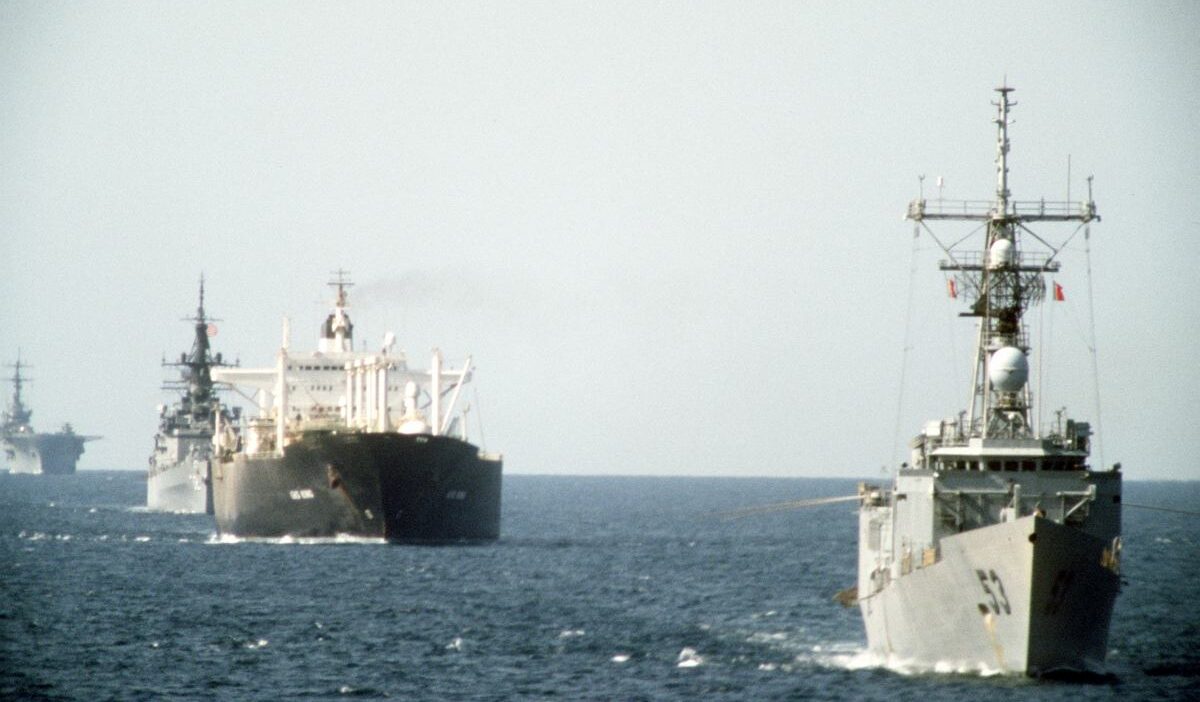
The US Navy once faced this task during the so-called “Tanker War” in the 1980s, part of the Iran-Iraq War (1980-88). Unable to achieve land success, both sides escalated attacks on the other’s oil export ships—their primary war funding source. For three years, sporadic Iraqi Exocet missile attacks occurred. Escalation began in 1984 with Iranian attacks. Mutual strikes increasingly targeted neutral-flagged ships. In 1987, Kuwait, supporting Iraq, drew the US into the conflict. Before convoys started, Iraqi missiles accidentally hit the USS Stark, killing 37 sailors and severely damaging the frigate. The next year, the USS Samuel B. Roberts struck an Iranian mine, causing heavy damage but no fatalities.
For nearly a year starting mid-1987, US ships escorted Kuwaiti tankowthers and other vessels mainly to the Strait of Hormuz. Iranian mines proved the main threat; the US was initially unprepared but became more effective at countering small Iranian boats and nighttime mine-laying ships, involving special forces, helicopters, and aircraft. Regardless, from autumn 1987 to winter 1988, roughly 20 ships were damaged monthly, with only 6 sunk. The maritime war only ended with the Iran-Iraq War’s conclusion in August 1988. Those events—small boat attacks, mining, occasional land-launched missiles and drones—may repeat now. Providing completely effective protection against such threats is extremely difficult. However, unlike Bab al-Mandab (which can be bypassed around Africa), the strait has no alternative. It’s a matter of balancing risk costs between shipowners, insurers, and cargo owners, plus the land war’s progress. All involved can hope the conflict ends before the dangerous strait must be regularly traversed.