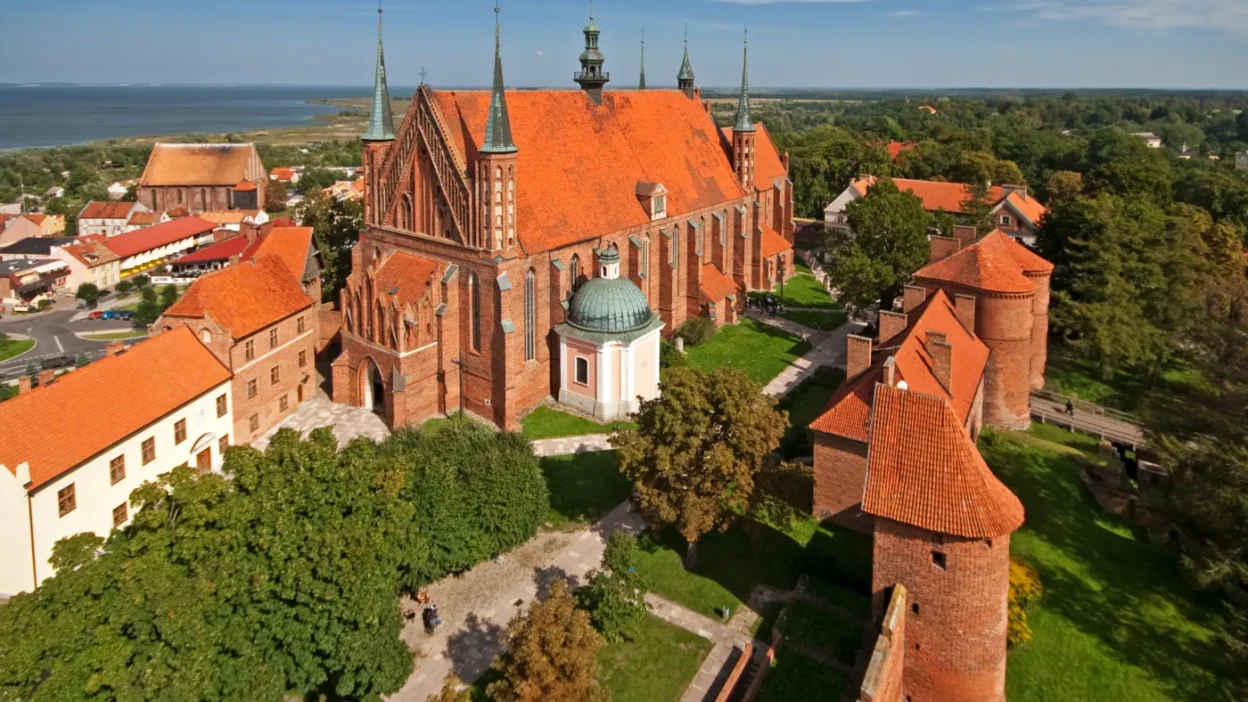
Archaeological research at Frombork Cathedral in Poland has uncovered a remarkable collection of silk garments, chalices made of skin and paper, and other liturgical items.
Discovery in the Frombork Cathedral
Exceptional discoveries have been made during archaeological excavations in the canon’s crypt at Frombork Cathedral, including chalices crafted from skin.
Silk vestments and cushions, alongside chalices made of wood, leather, and paper, were found during archaeological research in the crypt of canons at Frombork Cathedral. The discoveries may expand knowledge about the burials of clergy, announced the Nicolaus Copernicus Foundation, which is leading the research, on Tuesday.
Historical Context of Frombork Cathedral
The Frombork Cathedral, situated on a hill overlooking the Vistula Lagoon, serves as a burial place for canons and Warmian bishops. The most famous canon buried within the church is Nicolaus Copernicus, whose remains were discovered in 2005 under the floor. The burial site of his uncle, Bishop Lucas Watzenrode, remains undiscovered.
Details of the Archaeological Findings
The ongoing archaeological research in the canonical crypt of the Cathedral of the Assumption of the Blessed Virgin Mary and St. Andrew in Frombork has revealed a series of interesting discoveries that could significantly expand existing knowledge, particularly regarding the burials of clergy. However, the currently presented results are preliminary findings accompanying the main research work.
The research has confirmed the existence of the largest collection of silk vestments discovered during archaeological excavations in Poland, as well as unique liturgical garments made of silk, including the largest collection of such cassocks, which are exceptionally rare. The research also revealed the presence of reliquary crosses, the origin and function of which will be the subject of further analysis.
Unique Chalices and Textiles Found
Rosaries, chalices with hosts made of wood, leather, and paper were found in the canons’ coffins. This constitutes the largest collection of its kind in Poland. Wooden chalices have typically been found previously, while leather and paper chalices are practically unknown.
Elements of liturgical vestments and coffin linings were identified during the research. Other textiles included silk cushions, fragments of dalmatics, and palliums.
Significance of the Finds
These finds constitute one of the most valuable collections of sepulchral (funeral) fabrics in Poland from the early 18th to the early 20th century. The remains and textiles survived thanks to the specific microclimate of the crypt.
This collection will allow for the study of fashion and the symbolism of clerical attire, as well as burial customs in this part of Poland. It will also allow for the understanding of the weaving techniques used and the trade routes of silk.
Ongoing Search for Bishop Watzenrode
The main goal of the project and the undertaken research is an attempt to locate the remains of Bishop Lucas Watzenrode (uncle of Nicolaus Copernicus) and other bishops from the 16th century within Frombork Cathedral. At this stage of the research, there is no conclusive information, as the analyzed area is another stage of field work. Research has been conducted on the discovered, presumed bishop’s crypt, and a comprehensive survey of the cathedral has been carried out using, among other things, ground-penetrating radar.
Hypotheses and Future Research
Currently, the hypothesis is being verified that a smaller crypt may have previously existed in the investigated area, in which – or under which – the burials of former Warmian bishops may be located. The research work is ongoing, and the current stage raises more questions than answers. Detailed information will be provided after the completion of the process of securing and developing the finds.
Project Funding and Collaboration
The “Copernicus 2043” project is funded by the Ministry of Science and Higher Education as part of the “Science for Society” program. The research is carried out by the Nicolaus Copernicus Foundation in cooperation with scientists associated with many institutions and universities in Poland.
Historical Burials at Frombork Cathedral
Frombork Cathedral contains the earthly remains of bishops, canons, but also lay people. Archdiocese of Warmia Archives Director, Fr. Prof. Andrzej Kopiczko previously informed PAP that the oldest known burial took place in the basement of the first building, erected after the capital of Warmia was moved from Braniewo to Frombork. Bishop Henryk Fleming made this decision, and when he died on July 15, 1300, he found his resting place in the presbytery next to the altar of the Blessed Virgin Mary, located in the present church on the north side of the altar, where Mass is currently celebrated.
Copernicus and Watzenrode’s Graves
Visitors to the cathedral most often stop at the grave of Canon Nicolaus Copernicus, located near the altar of the Holy Cross. The burial place of Bishop Lucas Watzenrode is still being sought, as it would allow for the final confirmation of the authenticity of the remains of the great astronomer.
Several years ago, a crypt was opened in the chapel of the Savior (Holy Relics), built by Bishop Krzysztof Andrzej Jan Szembek, and well-preserved coffins of the founder and four of his successors (A. Hatten, J. Geritz, A. Thiel, A. Bludau) and Canon Ossoliński were found there. In front of the altar in the main nave, the tombstone of the last bishop buried outside the crypt, directly under the floor, Adam Stanisław Grabowski, who greatly contributed to Warmia in the pre-partition period, is easily visible.
The entire Frombork Cathedral is such a large underground cemetery, as evidenced by the numerous preserved epitaphs and tombstones. However, as early as the second half of the 17th century, concerns arose that they might threaten the stability of the building. For this reason, by decision of the chapter in 1682, the placement of epitaphs on the walls was made dependent on the bishop’s consent. In 1709, a decision was made to build a crypt, which was called the “common grave”. Canon Piotr Maria Ruggieri, who died in 1739, was the first to be buried there, and then subsequent canons. Over 100 people were buried there, and recent research has made it possible to identify the coffins of many of them.
Unfortunately, in 1945, they were desecrated by Soviet soldiers and the place is waiting for tidying up and – we hope – making it available to visitors. But in the early 20th century, this crypt also filled up, so there was a need to find another burial place for Warmian canons.