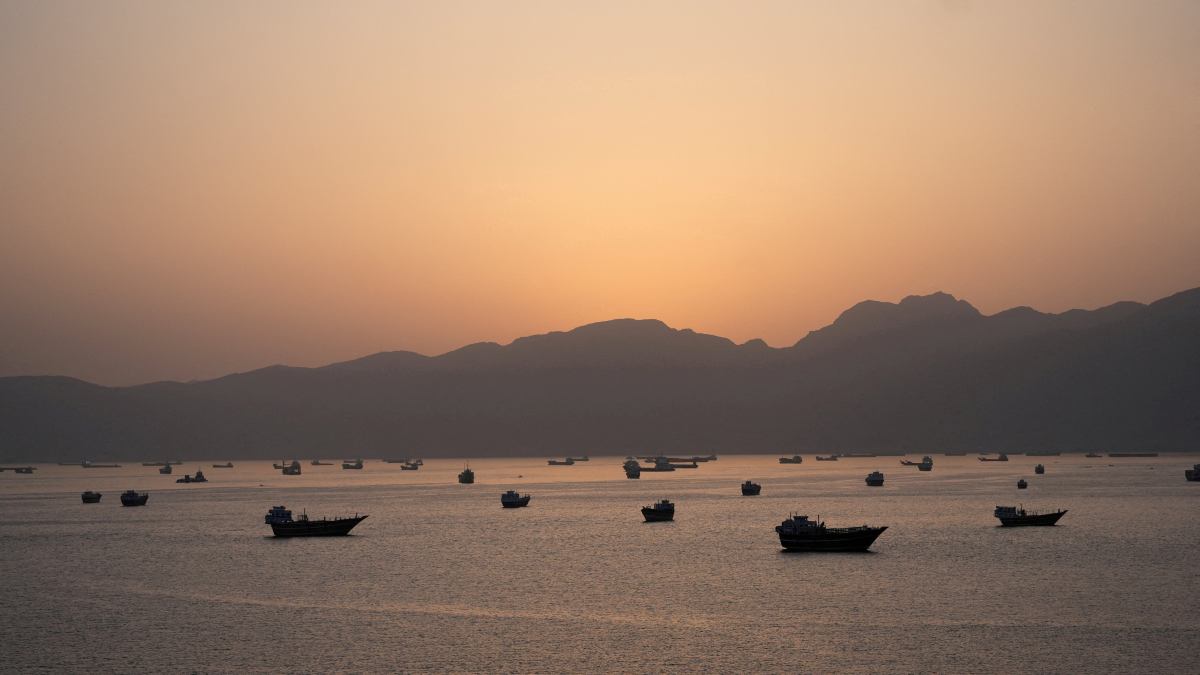
Iran and the US are escalating tensions in the Strait of Hormuz following a US operation to secure passage for neutral vessels, with both sides issuing warnings.
Iran Issues Warning Over Strait of Hormuz
Mohammad Bagher Ghalibaf, Iran’s chief negotiator and parliamentary speaker, warned Washington against further actions in the Strait of Hormuz. This is a response to the US “Operation Freedom” aimed at facilitating the passage of ships from neutral countries through the strait.
Ghalibaf stated, “A new balance in the Strait of Hormuz is stabilizing. The security of navigation and energy transit is in danger due to the violation of the ceasefire and the imposition of a blockade by the United States and its allies; of course, their evil will be minimized.”
The Iranian politician added, “We know very well that maintaining the current state of affairs is unbearable for America; while we haven’t even started.”
Clashes in the Strait of Hormuz and US Response
The US military reported that its Apache and Seahawk helicopters attacked six Iranian boats allegedly threatening commercial shipping. US Central Command also stated its forces repelled missile and drone attacks.
US Opens Passage, Iran Denies Attacks on UAE
Admiral Brad Cooper, CENTCOM commander, announced the US had opened a passage in the strait free of Iranian mines. He claimed Iran launched cruise missiles, drones, and small boats against civilian ships under US protection, asserting that “every” threat was neutralized.
Trump’s Response and “Operation Freedom”
President Trump previously warned that any attempt by Iran to block the strait would meet a decisive response. He presented “Operation Freedom” as a humanitarian operation to assist sailors stranded on hundreds of ships in the Persian Gulf, citing concerns about dwindling food supplies.
UAE Under Fire, Iran Dismisses US Accusations
The United Arab Emirates reported its air defense intercepted some Iranian missiles and drones. Authorities stated Iran fired 15 missiles and four drones, with one drone causing a fire at a key oil facility in Fujairah, injuring three Indian nationals.
The UAE’s Foreign Ministry called the attacks a “dangerous escalation” and “unacceptable violation.” They also reported an Iranian attack on a tanker linked to the state-owned ADNOC company.
Iran Denies Direct Involvement, Blames US
Tehran did not directly confirm attacks on the UAE, but Iranian state television cited an anonymous military official claiming Iran “had no plan” to attack the Emirates or its oil fields. The official blamed the US for the escalating tensions.
The official stated, “What happened was the result of the US military’s adventurism, which aimed to create a passage for ships to illegally pass through the forbidden corridors of the Strait of Hormuz. The US military must be held accountable.”
Trump Downplays Breach of Ceasefire
In an interview with ABC News, Donald Trump did not definitively state whether Iran had violated the existing ceasefire. He described it as “not a heavy barrage” and said the matter was under analysis.
Trump warned, “It’s better for Iran to hope the ceasefire holds. The best thing that can happen to them is that we maintain it.” He also threatened that Iran “will be wiped off the face of the Earth.”
The US President added that the United States “takes care of the world” and suggested South Korea should participate in the mission, as one of the attacked ships was South Korean.
Strategic Importance of the Strait of Hormuz
The Strait of Hormuz is a crucial global oil transportation route. Before the conflict, it carried approximately one-fifth of the world’s oil supply. Blocking it would severely impact the economies of Europe and Asia, which rely on oil and gas from the Persian Gulf.
Disruptions are already affecting markets, with oil prices rising and stock exchanges falling. European leaders have appealed to Iran to return to talks. Ursula von der Leyen stated that security in the Gulf region has direct consequences for Europe. German Chancellor Friedrich Merz urged Tehran to stop “holding the region and the world hostage.”
Iran Insists on Control of the Strait
Iran maintains it will not relinquish control of the strait. Iranian military officials warned that ships wanting to pass through the Hormuz must coordinate with Tehran, and any foreign military force approaching the strait could be attacked.
US Intelligence Assessment of Iran’s Nuclear Program
Amidst the escalation in the Hormuz, the US intelligence assesses that the time needed for Iran to build a nuclear weapon remains around a year, unchanged since last summer.
The US and Israel began attacks on Iran on February 28th, aiming to prevent Tehran from acquiring nuclear weapons. However, recent US and Israeli strikes have primarily targeted conventional military objectives, although Israel has also attacked key nuclear facilities.
Following previous US strikes on nuclear complexes in Natanz, Fordo, and Isfahan in June 2025, US intelligence extended the estimated time for Iran to build a weapon from several months to approximately 9-12 months. However, concerns remain regarding Iran’s stockpile of highly enriched uranium. Approximately 440 kilograms of uranium enriched to 60 percent remains unverified by the International Atomic Energy Agency.
Eric Brewer, a former US intelligence analyst with the Nuclear Threat Initiative, stated, “To the best of our knowledge, Iran still possesses all of its nuclear material. It is likely located deep underground, where US missiles cannot reach.”