




Buying a Country Home? A New Statement Will Appear in the Notarial Deed
Buyers of rural properties in Poland will soon be required to sign a formal statement acknowledging potential agricultural nuisances under a new government bill. New Obligations for Rural Property...
Buyers of rural properties in Poland will soon be required to sign a formal statement acknowledging potential agricultural nuisances under a new government bill.
Table Of Content
- New Obligations for Rural Property Buyers
- Farm Noise, Odors, and Neighbor Claims
- Night Agricultural Work Without Fines in Specific Situations
- “Lex Smród” and the Dispute Over Industrial Farms
- Lack of Data on the Scale of Lawsuits and Fines Against Farmers
- Government Adoption and Future Parliamentary Path
New Obligations for Rural Property Buyers
Buying a house or plot outside the city is set to involve a new obligation. The property buyer will have to confirm in the notarial deed that they are aware of possible nuisances resulting from agricultural activities carried out in the vicinity. The Council of Ministers has adopted a draft of regulations strengthening the protection of farmers against claims regarding noise, odors, and night field work, among other things. The regulation, termed “Lex Smród” by opponents, does not mean residents are completely deprived of the right to go to court.
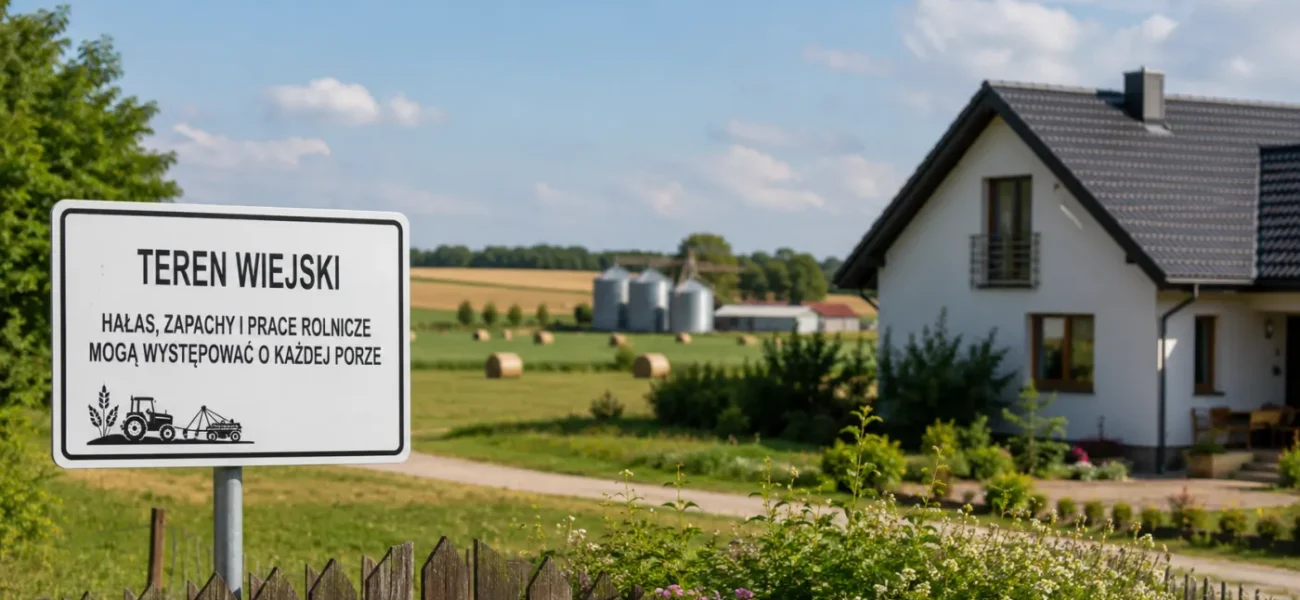
One of the most noticeable changes for buyers will be a new element in the notarial deed. If the transaction concerns a property located outside administrative city limits, the buyer must confirm that they realize the possible disturbances related to agricultural activities conducted on neighboring properties. The solution is also to cover the transfer of perpetual usufruct rights.
This is not a separate form signed after moving in, but rather information to be included at the stage of the legal transaction. The Ministry of Agriculture and Rural Development argues that a person buying property in a rural area should know from the beginning that odors from farms, animal noises, machine noise, or work performed at unusual hours may occur nearby.
As previously described by Wyborcza.biz, the initial justification of the project indicated that such a solution was intended to limit the possibility of later questioning the typical consequences of agricultural activity. The ministry later presented the obligation primarily as an information and educational tool.
This is an important distinction. Signing the statement will not mean the buyer automatically waives legal protection. However, the document could matter in the event of a later court dispute because it will confirm that the buyer knew the character of the property’s surroundings at the time of purchase.
Farm Noise, Odors, and Neighbor Claims
Much more serious consequences may stem from the planned amendment to the Civil Code concerning so-called emissions—impacts originating from one property and felt on another. This refers specifically to odors, noise, dust, and other nuisances.
The government draft assumes special treatment for agricultural activity, which as a rule is to be considered as falling within the limits of normal property use. However, the protection of the farmer will not be unconditional; it is to apply to activities conducted in accordance with the law and the principles of proper agricultural management.
In practice, this may significantly change the situation of the parties in a trial. According to the regulatory impact assessment, a person filing a claim regarding agricultural emissions will have to prove the existence of circumstances excluding the special protection of the farm, such as conducting operations contrary to regulations or the rules of proper agricultural management.
This does not mean that every odor or noise coming from a farm is automatically legalized regardless of its intensity and cause. The draft is intended to strengthen the position of those farms that operate in accordance with regulations.
Night Agricultural Work Without Fines in Specific Situations
The second major area of changes concerns the Code of Minor Offenses. Current regulations provide for liability for disturbing peace, public order, or night rest. The problem arises in situations where the source of noise is not parties or public order behavior, but necessary agricultural work.
The draft aims to exclude punishability in cases related to properly conducted agricultural activity. The significance of this change is most clearly seen during harvest. If the weather forecast forces crops to be gathered before rain, combines and tractors may also work late in the evening or at night. Similar situations result from the biological cycle of plants and animals.
The Ministry of Agriculture and Rural Development emphasizes that many tasks cannot be restricted to standard daytime hours. Their timing depends on the weather, season, and production conditions.
Minister of Agriculture Stefan Krajewski pointed out after the government adopted the project that an increasing number of people choose rural areas as places to live without engaging in farming. At the same time, the countryside remains a place of food production, inherently tied to animal noises, machinery work, and characteristic odors.
“Lex Smród” and the Dispute Over Industrial Farms
The project has faced decisive opposition from certain social organizations since its inception. The Green REV Institute and the Safe Food Federation refer to it as “Lex Smród.” Critics point out primarily that the proposed solutions do not create a clear distinction between traditional farming and large-scale animal production.
According to the Green REV Institute, the project could make it difficult for residents to pursue claims in cases of serious nuisances associated with large farm operations. The organization also points to potential consequences of intensive breeding for the environment, residents’ quality of life, and the potential for tourism and agritourism activities.
Reservations were also raised during work on the project by the Institute of Acoustic Ecology. One significant remark concerned the concept of “rules of proper agricultural management,” with critics noting that the term is not sufficiently precise despite its potential key importance in resolving court disputes. Similar doubts regarding the interpretation of this phrasing were presented by the Wielkopolska Agricultural Chamber.
At the same time, the project does not repeal environmental regulations applicable to large installations. During parliamentary work in June, a representative of the Ministry of Climate and Environment pointed out that obligations regarding the acquisition of required permits by large-scale farms stem from the Environmental Protection Law and are not nullified by the proposed act.
Lack of Data on the Scale of Lawsuits and Fines Against Farmers
One of the most serious criticisms of the legislative process is the absence of complete data allowing an assessment of the scale of the problem the new regulations are intended to solve. The regulatory impact assessment describes conflicts between agricultural activity and new rural settlement but does not present the complete number of civil lawsuits, fines, or final judgments related to typical agricultural nuisances.
This issue was highlighted by the Institute of Acoustic Ecology, which argued during consultations that before far-reaching changes to liability rules, the actual frequency of such conflicts should be more accurately determined.
A benchmark for the discussion has become the widely covered case of Szymon Kluka, a farmer from Grodzisk in the Łódź Voivodeship. The multi-year conflict concerned his pig farming operation and the impact of the pigsty on neighboring properties.
The farmer initially maintained about 120 pigs and 10 cattle, later expanding production to 360 pigs. The dispute with neighbors lasted over a decade. The court ruled that the farm’s impact exceeded the permissible level and ordered financial compensation for the neighbors, alongside obligations meant to limit breeding nuisances.
The case caused a major stir in the agricultural community and became one of the arguments used by proponents of legally strengthening the protection of legally conducted agricultural activities.
Government Adoption and Future Parliamentary Path
The draft concerning the protection of rural production functions was submitted for public consultation at the end of March 2026, with a deadline for comments set for April 30. In the government legislative work registry, it received the number UPRO8.
The Council of Ministers adopted the draft on August 18, 2026. However, this does not mean the new regulations have entered into force. The project must undergo the full parliamentary procedure. Only after the Sejm passes the act, the Senate considers it, the president signs it, and publication occurs will it become binding law.
Concurrently, a presidential draft concerning the protection of the rural production function is present in the Sejm, introduced in April 2026. This bill also aims to regulate relations between those conducting legal agricultural production and individuals living in rural areas. The final shape of the regulations will therefore depend on further parliamentary work.