





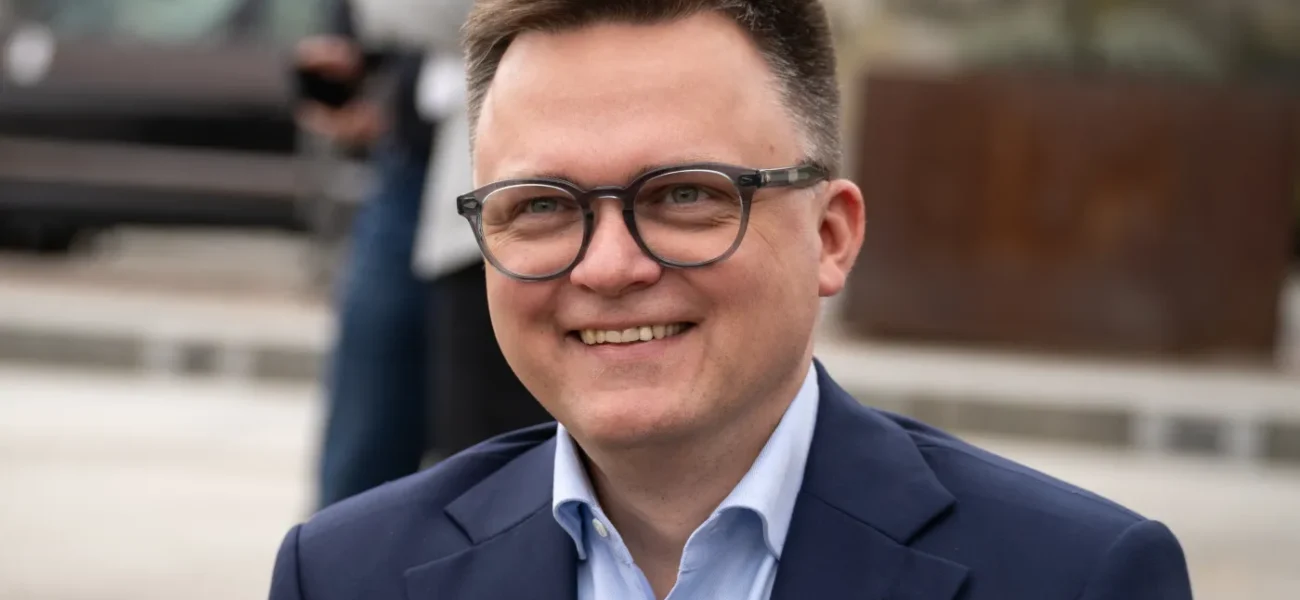
Hołownia Eyes Major Political Comeback Amid Concrete Coalition Proposals
Former Sejm speaker Szymon Hołownia is back at the center of governing coalition talks regarding the 2027 parliamentary elections, with three distinct scenarios currently under consideration. Three...
Former Sejm speaker Szymon Hołownia is back at the center of governing coalition talks regarding the 2027 parliamentary elections, with three distinct scenarios currently under consideration.
Table Of Content
Three Scenarios for Hołownia’s Future
Szymon Hołownia has once again found himself at the center of talks concerning the future of the ruling camp. The former Sejm speaker and founder of Poland 2050 no longer leads the grouping, but his name is returning in negotiations regarding the government, the 2027 parliamentary elections, and a possible rebuilding of the center of the political scene. According to Rzeczpospolita, three scenarios concerning his future are being considered, though the path to realizing each of them remains complicated.
The most spectacular variant assumes Szymon Hołownia’s return to the top leadership of the ruling coalition. As Rzeczpospolita reports, this would involve the position of deputy prime minister combined with heading the Ministry of Culture and National Heritage. Włodzimierz Czarzasty insists that the political offer for Hołownia has existed for quite some time and remains current, while coalition members note this would not be an unconditional return to the government.
Conditions for a Government Return
According to the newspaper’s interlocutors, Hołownia would first have to rebuild his position within his own environment. Expectations reportedly include regaining real influence over Poland 2050, taking over the leadership of the party and parliamentary club, and bringing about the reunification of circles that drifted apart following an internal conflict. This very condition makes the governmental project currently primarily a political design rather than a finalized personnel decision.
Additionally, the media image of the situation is not uniform. Newsweek reported on August 13 that Hołownia’s attempt to regain control over the parliamentary club did not end in success, and the former Poland 2050 leader is not slated to enter Donald Trump’s government at this stage. Meanwhile, Rzeczpospolita’s findings published a day later show that the political proposal has not been definitively taken off the table.
Poland 2050 Split and Loss of Position
A key problem is the situation of the grouping created by Szymon Hołownia. Since January 31, 2026, Poland 2050 has been led by Katarzyna Pełczyńska-Nałęcz, who defeated Paulina Hennig-Kloska in a repeated second round of the chairperson election. A few weeks later, a deep split occurred, with a portion of parliamentarians leaving the grouping to form the Centrum club.
Following the division, Poland 2050 and the Centrum club each had 15 deputies, which is the minimum number required for a parliamentary club to function. Among the politicians outside Poland 2050 were Paulina Hennig-Kloska, Ryszard Petru, Mirosław Suchoń, Aleksandra Leo, Sławomir Ćwik, and Rafał Kasprzyk. Consequently, recreating the formation to its pre-split shape would require a renewed agreement between people who chose a political parting months prior.
Joint PSL and Poland 2050 List
The second scenario concerns a rapprochement between Poland 2050 and the Polish Peasant Party (PSL). Energy Minister Miłosz Motyka from PSL told Rzeczpospolita that the PSL would like both environments to run together in the 2027 parliamentary elections, effectively attempting to rebuild the electoral cooperation known from the Third Way.
This solution is supported by electoral arithmetic, as Poland 2050 has struggled with independent voter support. In a June Opinia24 poll, the grouping reached 1.8 percent, while PSL registered 2.7 percent, placing both formations below the 5 percent threshold for independent parties. Pre-election cooperation could thus mitigate the risk of losing parliamentary representation.
Parliamentary Majority and the 15 Deputies
The matter extends beyond the future of a single politician, as the post-split balance of power in the Sejm became more complex. The club led by associates of Katarzyna Pełczyńska-Nałęcz retained 15 deputies, whose votes remain vital for the stability of the parliamentary majority.
Tensions between Pełczyńska-Nałęcz and other government partners involve the pace of reforms and the coalition’s functioning. While Hołownia has sought to regain initiative and influence within his former base since July, his political future is tied to ongoing friction over the center of the ruling camp.
Third Offer Outside the Ruling Camp
The third variant is the most surprising, with Rzeczpospolita indicating Hołownia has the option to cooperate with Mateusz Morawiecki and the Development Plus association. This would represent a radical departure from entering the government or aligning with PSL, given Hołownia’s years spent opposing Law and Justice (PiS) governance.
Even politicians close to the former Sejm speaker cautiously view this possibility, noting that moving to an environment associated with the former PiS prime minister would be difficult for Hołownia’s voters to accept. There is currently no information confirming a formal agreement in this regard.
Political Future After UN Bid
Hołownia’s current activity follows a period of uncertainty regarding his political future, notably his autumn 2025 bid for United Nations High Commissioner for Refugees, where he made the shortlist but ultimately did not secure the post. Concurrently, he announced his departure from the post of Poland 2050 leader.
Remaining in the Sejm after losing the party leadership, Hołownia’s political weight diminished, though he later admitted stepping down from party leadership was a mistake. Today’s situation presents him with difficult choices: trying to reclaim his party, rebuilding a centro-electoral project with PSL, or shifting course entirely toward Mateusz Morawiecki’s circle.