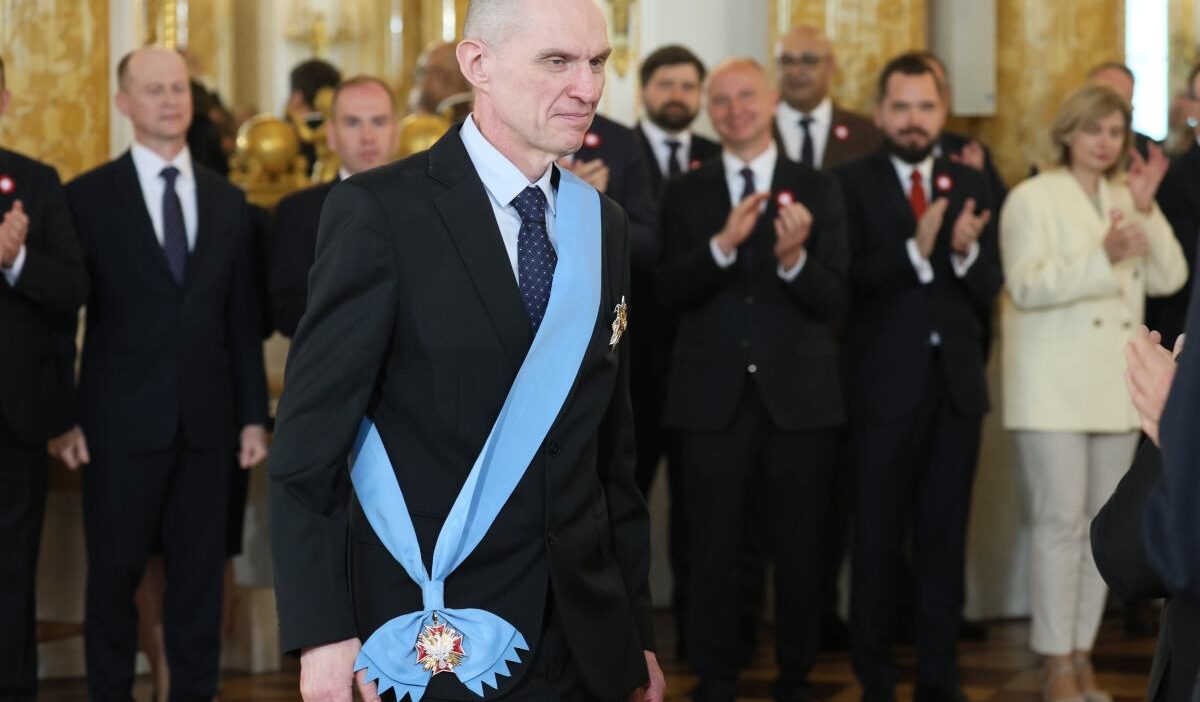
Polish President Karol Nawrocki posthumously awarded the Order of the White Eagle to Andrzej Poczobut, a journalist imprisoned in Belarus, during a Warsaw ceremony.
Andrzej Poczobut Honored with Poland’s Highest Distinction
Karol Nawrocki conferred the Order of the White Eagle on Andrzej Poczobut posthumously during last year’s National Independence Day, recognizing his significant contributions to the Polish community in Belarus, particularly his advocacy for human rights and resistance against totalitarian regimes.
Poczobut was imprisoned in a Belarusian penal colony at the time of the award.
Other Recipients of the Order of the White Eagle
Agnieszka Duczmal-Jaroszewska (conductor and founder of the Polish Radio Chamber Orchestra), Hanna Łukowska-Karniej (opposition activist from the Polish People’s Republic era), and director Lech Majewski also received the Order of the White Eagle during the ceremony held at the Royal Castle in Warsaw.
The Significance of the Order of the White Eagle
The Order of the White Eagle, established in 1705 and reactivated in 1921, is Poland’s highest decoration. It is awarded for outstanding civil and military merits to distinguished Poles and high-ranking foreign dignitaries.
President Nawrocki’s Address
Karol Nawrocki reflected on the 235th anniversary of the Polish decision to reform the declining Polish-Lithuanian Commonwealth, praising the intellectual depth of those who drafted the Constitution of May 3rd, despite it ultimately becoming a testament to independence rather than a path to revival.
He emphasized the historical context of the ceremony taking place at the Royal Castle in Warsaw, linking it to the drafting and adoption of the Constitution of May 3rd and the significance of the national awards.
Nawrocki stated that, as a former director of the Institute of National Remembrance, he understands the weight of words like “heroism” and “unyielding,” and affirmed that Andrzej Poczobut is a hero who was willing to face imprisonment for Polish identity, historical truth, and human rights under the Lukashenko regime. He described Poczobut’s return from prison as a victory.
Andrzej Poczobut’s Response
Andrzej Poczobut expressed humility upon receiving the high state honor, stating he did not feel like a hero, but rather that the heroes were the soldiers of the Home Army.
He described himself as an ordinary person trying to act decently in indecent times, and acknowledged the award as a symbolic recognition of the activities of all members of the Association of Poles in Belarus, who continue their work despite repression.
Poczobut highlighted the persecution faced by individuals simply for wanting their children to learn the Polish language and for honoring the memory of heroes.
Donald Tusk on Poczobut’s Release
Prime Minister Donald Tusk announced on April 28th that Belarusian authorities had released Andrzej Poczobut from the penal colony, describing it as the culmination of a two-year diplomatic effort involving Polish services, diplomats, prosecutors, and assistance from American, Romanian, and Moldovan allies.
Nawrocki on Poczobut’s Strength
Karol Nawrocki stated that Andrzej Poczobut, now free and in Poland, demonstrated the strength of Polish identity and commitment to Polish values, for which he paid a high price in prison.
He noted that the process of Poczobut’s release was strengthened by his discussion with President Donald Trump, beginning in September 2025, urging him to raise the issue in negotiations with the Belarusian regime.
Poczobut’s Arrest and Charges
Poczobut had collaborated with Polish media, including “Gazeta Wyborcza,” reporting on the situation in Belarus. He was arrested by Belarusian authorities in March 2021 and accused of “rehabilitating Nazism,” and subsequently sentenced to eight years in a strict-regime penal colony in February 2023.