Poland’s Supreme Administrative Court overturned a lower court ruling and mandated the registration of a same-sex marriage performed abroad on Friday, prompting a response from the ruling PiS party.
Supreme Administrative Court Overturns Lower Court Decision
The Supreme Administrative Court (NSA) on Friday, March 20th, overturned a decision by a Warsaw administrative court, as well as an earlier ruling, refusing to register a marriage certificate of Polish citizens of the same sex concluded abroad.
The NSA also ordered the head of the Warsaw civil registry office to transfer such a same-sex marriage certificate to the Polish register.
PiS Announces Constitutional Tribunal Appeal
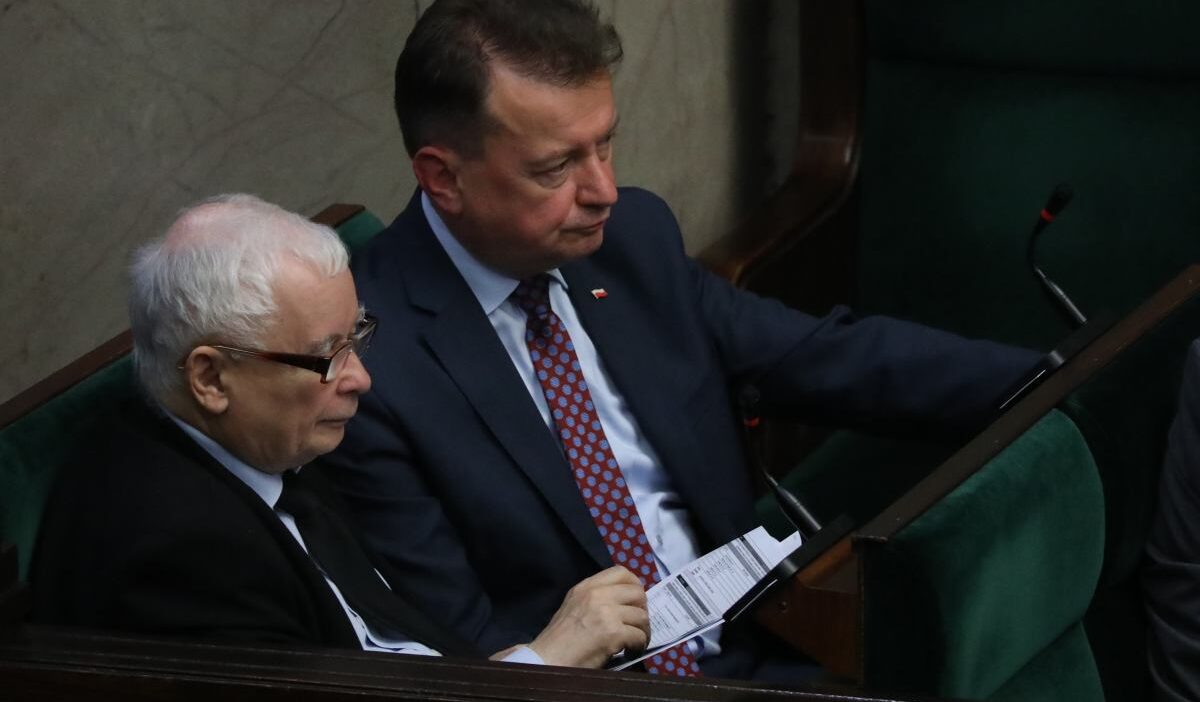
During a press conference in the Sejm on Friday, Mariusz Błaszczak, head of the PiS parliamentary club, stated that the NSA’s ruling cannot be appealed to the Constitutional Tribunal, but the regulation upon which the NSA based its decision can be challenged.
“Therefore, the parliamentary club of Law and Justice will submit such a motion to the Constitutional Tribunal. Professor Marcin Warchoł prepared this motion, and it is already ready,” he informed reporters.
Warchoł: Ruling is Illegal and Unconstitutional
Warchoł emphasized that “regulations are not abstract, suspended in a vacuum.” He stated, “These regulations live in concrete realities, and unfortunately, we are seeing those concrete realities today. The administrative court has given these regulations such an illegal and unconstitutional meaning, and we will appeal this understanding of the norm to the Constitutional Tribunal.”
Constitutional Concerns Raised
Warchoł asserted that the NSA issued an “illegal and unconstitutional” ruling, imposing solutions “foreign to the Polish constitution and Polish legal culture.” He added, “Poles have never agreed to equate same-sex marriages with marriages as referred to in Art. 18 of the constitution.”
NSA Reasoning Based on Constitutional Interpretation
In the justification for Friday’s ruling, Judge Leszek Kiermaszek assessed that, “in the opinion of the court, Article 18 of the constitution does not allow for the conclusion that it constitutes an absolute obstacle to recognizing a marriage of persons of the same sex concluded in another EU member state in accordance with the legislation of that state, including the transfer of the act of this marriage to the Polish register by way of transcription.”
He added that the Polish constitution stipulates that “the institution of marriage in this understanding is under special care and protection of the Republic of Poland – just like family and motherhood.” However, “it is not possible to generate from this provision the thesis that – firstly – it prohibits the recognition of other unions between two people regardless of gender, and – secondly – that these other unions are not entitled to any level of protection.”
Non-Discrimination Principles
“A different understanding of this provision [Art. 18 of the Constitution] would be in conflict with the prohibition of discrimination in social life, including on the grounds of gender and sexual orientation,” Judge Kiermaszek noted.
Case Background: Marriage in Berlin
The ruling concerned the marriage of two Polish citizens legally concluded in Berlin in 2018. The couple decided to move to Poland and sought to have their marriage recognized in their home country, submitting an application for transcription of the German marriage certificate to the Polish civil registry. Their request was denied due to Polish law not permitting same-sex marriages.
EU Court of Justice Ruling Preceded NSA Decision
In a 2023 case, the NSA referred a preliminary question to the Court of Justice of the European Union (CJEU). Two years later, in November 2025, the CJEU ruled that a member state is obliged to recognize a same-sex marriage concluded legally in another EU country, even if the state’s own law does not recognize such unions. Following the CJEU’s response, the case returned to the NSA.