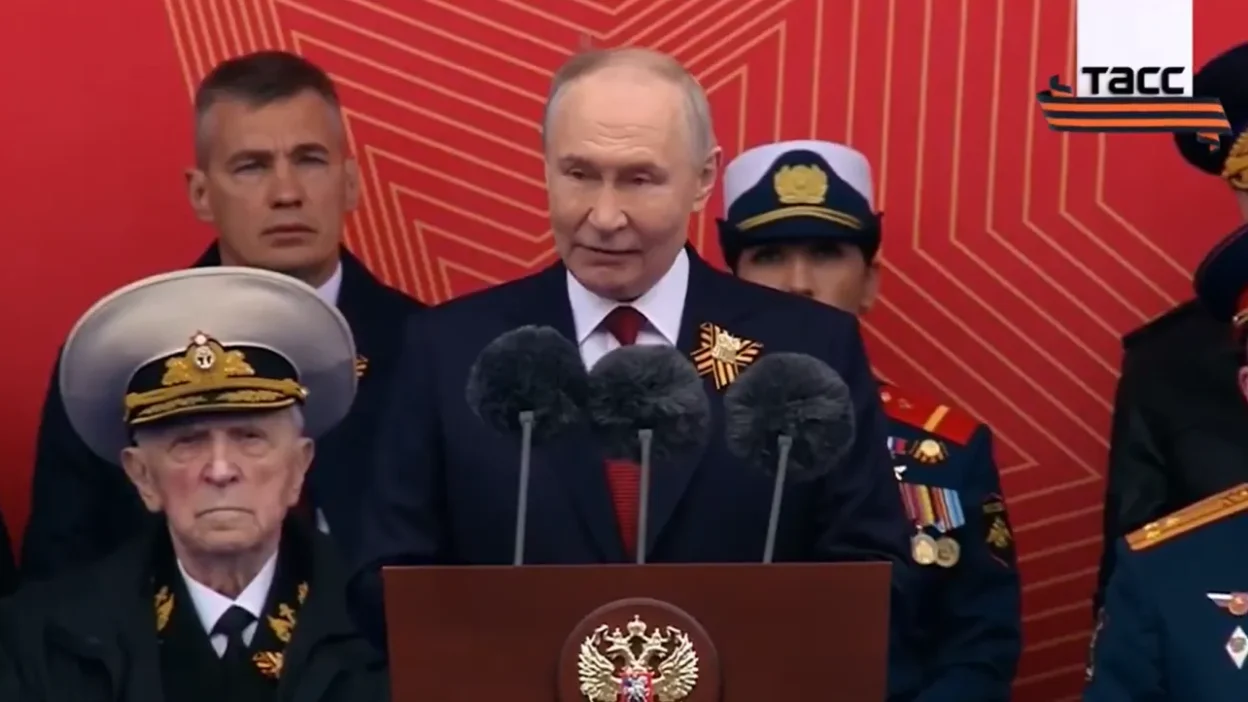
During Moscow’s 81st Victory Day parade, President Vladimir Putin leveraged the event to justify Russia’s war and accuse NATO of supporting an aggressive force, linking current actions to World War II.
. **Body:**
Putin Justifies War, Accuses NATO
During the 81st anniversary of the Soviet Union’s victory over Nazi Germany, Vladimir Putin again used the Red Square military parade to justify Russia’s war. He repeatedly linked World War II to the current offensive, asserting that soldiers in the “special military operation” confront an “aggressive force supported by the entire NATO bloc.”
This year’s Victory Day celebrations in Moscow were shadowed by the war in Ukraine and growing internal security concerns. Putin’s speech was the central event, connecting the memory of defeating Nazism with current Kremlin policy. He lauded the “heroic deed of the Soviet people” who “saved the world” and “put an end to total evil,” while also accusing European states of supporting Nazi Germany and participating in its crimes.
Putin emphasized the immense sacrifices made by the Soviet Union during the war, designating June 22, 1941, as one of Russia’s most tragic dates. The Kremlin consistently maintains its interpretation that the “Great Patriotic War” began with the German attack on the USSR, omitting the earlier aggression by the Third Reich and the Soviet Union against Poland in September 1939.
War in Ukraine Without the Word ‘Ukraine’
Putin’s speech once again notably avoided direct use of the name “Ukraine.” The Russian leader consistently employed the term “special military operation,” a core element of the Kremlin’s propaganda messaging since the invasion began.
His strongest remarks came when he likened contemporary Russian soldiers to the Red Army fighting the Third Reich, framing current military actions as a continuation of a historical struggle against an external threat. He stated, “The great feat of the generation of victors inspires soldiers performing tasks today as part of the special military operation. They are confronting an aggressive force that is armed and supported by the entire NATO bloc.”
Further in his address, Putin sought to convey an image of complete societal mobilization around the war. He mentioned not only soldiers but also defense industry workers, farmers, doctors, teachers, clergy, and volunteers, arguing that all are participating in the state’s war effort.
Moscow Under Ukrainian Drone Shadow
This year’s parade occurred in an atmosphere distinctly different from previous Kremlin-organized events. For several months, Moscow has regularly been within range of Ukrainian drones, prompting Russian security services to significantly tighten protective measures around strategic sites and state events.
In recent days, Russian media and propaganda channels frequently reported neutralizing unmanned aerial vehicles headed towards the capital. Due to the threat, air traffic was restricted at some airports, and additional patrols and air defense systems were deployed in central Moscow.
Fears of drone attacks became a critical symbol of this year’s commemorations. Just a few years ago, the Kremlin projected Russia as having an almost impenetrable “anti-access bubble,” protected by modern air defense systems. However, the war has demonstrated that Ukrainian drones can penetrate hundreds of kilometers deep into Russian territory. This has increasingly challenged earlier assessments by Western military experts who long considered Russian air defense systems among the world’s most effective, as a series of successful Ukrainian operations against Russian airports, fuel depots, and military targets severely weakened the image of Russia’s “iron dome.”
Kremlin Seeks Public Mobilization
Putin’s address also carried a clear domestic dimension. The Russian leader sought to convince citizens that the country faced a historical trial demanding unity and sacrifice. His speech repeatedly invoked “moral strength,” “courage,” and the “ability to survive.”
Vladimir Putin stated that “Victory in the special military operation is forged both on the battlefield and in the rear.” This narrative emerges as the Russian economy increasingly feels the impact of the war, sanctions, and immense military expenditures. Despite the Kremlin maintaining strict control over the media landscape, independent research and analysis point to growing public fatigue with the prolonged conflict.
For months, Russian authorities have thus attempted to sustain public support by appealing to the memory of World War II and fostering the belief that contemporary Russia is once again battling an external threat. Victory Day remains one of the Kremlin’s most crucial tools for political mobilization and legitimizing the war waged against Ukraine.