Residents report wild boars damaging property and causing safety concerns in the Białołęka housing district despite repeated intervention requests.
Urban Wild Boar Problem
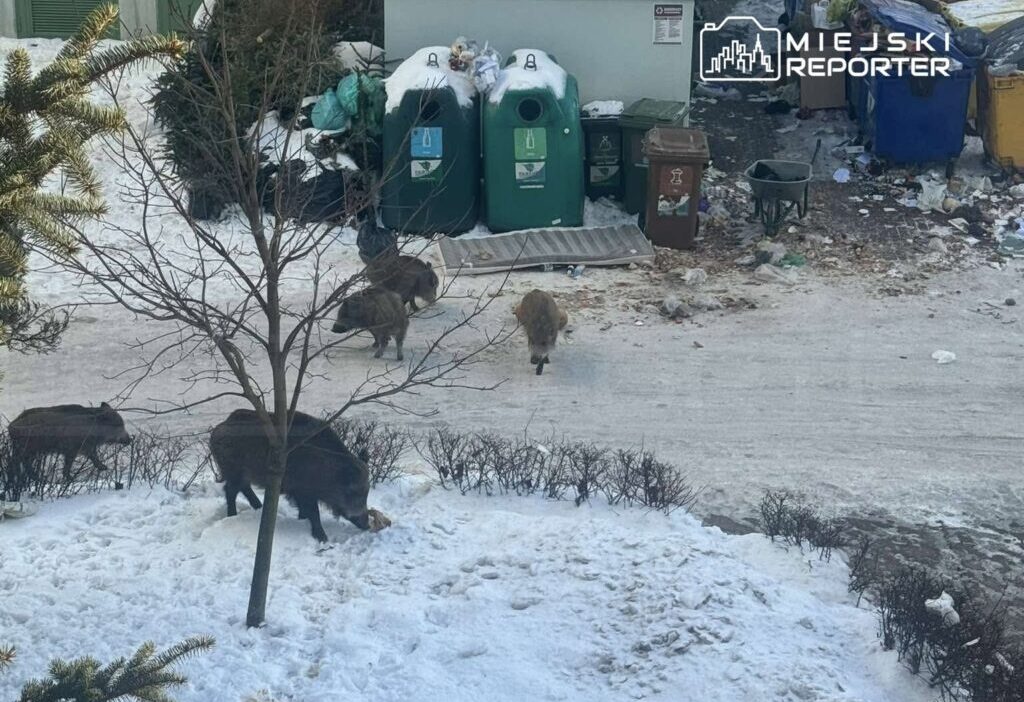
Residents of Aluzyczna Street in Białołęka (Tarchomin) report a herd of wild boars numbering several dozen has inhabited the housing estate for an extended period. The animals remain within the development, damaging sheds and waste bins, and causing residents to fear moving freely, especially after dark.
Intervention Requests Yield Little Response
Residents report daily complaints to both Warsaw Municipal Forests and Municipal Guard about the problem, with no effective action taken. The key issue is determining which Warsaw authority has competence to act against wild game and the restrictions imposed by African Swine Fever (ASF) regulations.
Responsibility Lies with Municipal Forests
In Warsaw, actions concerning so-called “thick-skinned game” (including wild boars, roe deer, moose) fall under Warsaw Municipal Forests. Their hunting guards (lowczy) conduct interventions related to wild boar presence in the city. The city provides 24-hour intervention numbers: 600 020 746 and 600 020 747, plus a reporting channel via the Warsaw 19115 app.
Districts Cannot Conduct Culls
District offices, including Białołęka, do not capture wild boars or conduct hunting operations. Their role is limited to securing selected green areas (e.g., fencing where possible), while operational actions remain with Municipal Forests.
ASF Prevents Relocation
The Ministry of Agriculture and Rural Development clarifies that relocating wild boars is prohibited under ASF regulations due to epidemiological risks, as boars are ASF reservoirs. State funding is available for ASF control measures (capture with euthanasia and disposal) formally mandated by authorities.
Urban Attractants Drive Problem
The persistent presence of wild boars in Warsaw, particularly near large green areas and migration corridors, is attributed to easy access to food in residential zones like unsecured bins, improperly discarded waste, and feeding. This creates permanent foraging sites.
Management Methods and Statistics
Due to risks in dense housing, Warsaw primarily uses cage trapping followed by euthanasia and disposal. Municipal Forests report 466 wild boars captured and euthanized in 2024, and 46 in the first half of 2025, with a target of 500 by June 2026. Complaints reached 5,128 in 2024, with a rising trend in 2025.
Reducing Urban Attractants
The city advises securing waste containers, avoiding improper disposal, and not feeding wild animals. If encountering a boar, residents should calmly retreat without sudden movements, avoid approaching, and not flee, as it may provoke an attack. Dogs must be kept on leashes.
Systemic Solutions Needed
The ministry notes the issue extends beyond wild boars to other game species, linking it to hunting and game resource management. It suggests systemic solutions should be initiated by the Ministry of Climate and Environment. Residents thus face the conflict between real safety/damage issues and ASF-related legal constraints on relocation.