Warsaw’s New Centre plan pushes a series of urban redesigns, but residents protest shrinking lanes, reduced parking and uncertain impacts on daily mobility.
Officials Push Forward ‘New Warsaw Centre’ Amid Residents’ Concerns
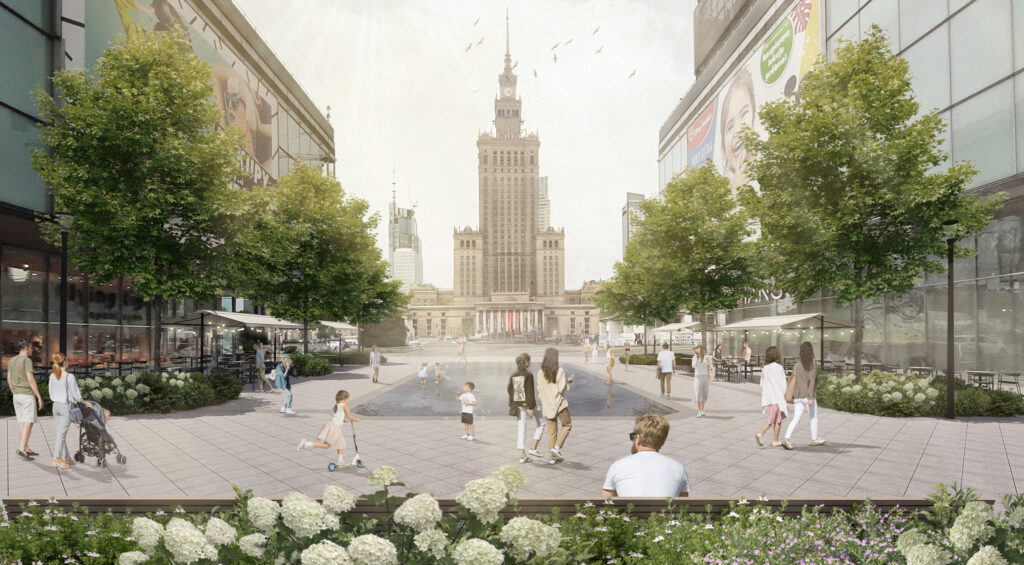
The Warsaw City Hall pushes further stages of the New Warsaw Centre project, from revamping the Złota and Zgoda area up to cleaning around the Palace of Culture and getting to the railway stations, while criticism grows that the official vision exceeds real needs of those who live, work and must navigate the centre efficiently.
2026 Budget Targets Completion of Złota–Zgoda, Grzybowski Square and PKiN Revamp
The 2026 budget earmarks finishing the Złota–Zgoda rebuild, redesigning the Grzybowski Square frontage and refreshing the surroundings of the Palace of Culture and Science, meaning prolonged interventions on key Śródmieście streets and squares such as Złota, Zgoda, Marszałkowska, Aleje Jerozolimskie, Krucza, the PKiN area and station approaches.
Złota–Zgoda Quarter Already Under Construction, Featuring Woonerfs and Tree Plantings
Work on the Złota–Zgoda quarter is underway with plans for woonerfs, new low‑green plantings, pedestrian pathways, and a shift of parking to underground facilities; the city also plans to remodel the Grzybowski–Twarda corridor and tidy the PKiN environs, adding low greenery, cleaning station pavilions, removing some food kiosks and resurfacing the Wisława Szymborska corridor to ease transfers from metro to Central Station.
A woonerf is a street type in a heavily urbanised zone prioritising safety, traffic calm, public space attractiveness and pedestrian‑cyclist priority, blending street, footpath, parking and meeting space while typically excluding through traffic but allowing public transport.
Marszałkowska Street Revamp Sparks Traffic Jams Concerns
The planned transformation of Marszałkowska, with a green corridor, tree planting and surface crossings aimed at pulling the centre around the Świętokrzyski Park and Palace of Culture, has drawn criticism that it slows traffic and creates bottlenecks, especially in the stretch between Świętokrzyska and Królewska, where travel times reportedly rose; similar worries apply to emergency services where street capacity matters.
Aleje Jerozolimskie Reimagined for 2030 with More Green Spaces
Future plans for Aleje Jerozolimskie after 2030 include fewer traffic lanes, a bus lane, cycle paths, wider pavements and more tree canopies, linked to a modernised median line that will shift timelines further, feeding concerns that incremental traffic restrictions are conditioning people to accept cars as less welcome in the centre.
Public Debate Focuses on Concrete Removal While Residents Bear the Cost
Debate around ‘deconcretisation’ of Warsaw spotlights the residents’ perspective that the real cost is paid through lane narrowing, parking elimination, fewer drop‑off spaces and travel delays; questions arise over who will deliver goods, service local businesses, or transport patients to hospitals when alternatives seem impractical, and a growing criticism asserts that municipal plans treat delivery, access and day‑to‑day logistics as add‑ons rather than foundations of Śródmieście. Additionally, the plan ties street changes to the Clean Transport Zone, limiting older vehicle entries and raising concerns for those who cannot switch cars quickly.