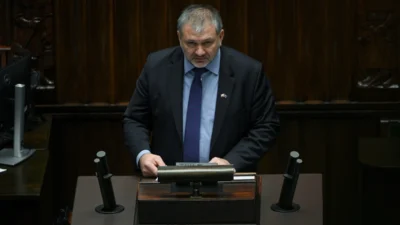
Poland’s Supreme Court refused to rule on Ombudsman’s questions about life imprisonment conditional releases amid ongoing dispute over judges appointed after 2017.
Prosecutor Seeks Disqualification of Entire Supreme Court Panel
The hearing began with a request from the Prosecutor’s Office to disqualify the entire panel in this case. According to prosecutor Mariusz Kowal delegated to the National Prosecutor’s Office, the panel includes individuals who cannot “form a court that fulfills citizens’ right to a court established by law.” For several months, prosecutors from the National Prosecutor’s Office have consistently filed such requests in many cases before the Supreme Court.
Dispute Over Judges Appointed After 2017
On Wednesday, Prosecutor Kowal repeated that these individuals (judges – PAP) “cannot and do not form a court that fulfills citizens’ right to a court established by law, independent, impartial, and impartial.” He added that this concerns the appointment of these individuals to the Supreme Court through a procedure involving the National Council of the Judiciary (KRS) in its form after the 2017 changes.
President Kapiński informed in response that the prosecutor’s request was left without consideration. He pointed out that “when we have a war raging directly across our border, we have hacker attacks, many unexplained cases, thousands of prosecutors working honestly, (…) we have a special team of prosecutors at the National Prosecutor’s Office that deals with the destruction (…) of the justice system, primarily the work of the Supreme Court.”
Prosecutor Accused of Political Motives
According to the President of the Criminal Chamber, these actions include sending letters to Supreme Court judges calling on them to stop adjudicating in the Supreme Court, as well as requests to exclude from adjudicating judges who participated in procedures before the KRS after 2017.
“Mr. Prosecutor is a member of a team appointed by the General Prosecutor. He is carrying out his specific political tasks. However, politics cannot be in this room, because politics will lead the justice system to a point where there will be no independent justice system,” emphasized President Kapiński. He simultaneously assured that as long as he is the President of the Supreme Court Chamber, he will “not allow a prosecutor to take such actions and for these actions to be effective.”
Prosecutor Leaves After 40 Minutes
Prosecutor Kowal, however, requested “a substantive consideration of the request to exclude judges by a court authorized to do so.” He emphasized that the request to exclude judges cannot be “considered by a person who is in this adjudicating panel.” – “This is one of the basic principles of law,” he added.
He also pointed out that as a prosecutor, he stands guard over the law “and will not speak on ideological and political issues.” He also said he would answer “only before a properly constituted court.” Ultimately, after 40 minutes of the hearing, the prosecutor left the Supreme Court courtroom.
Case Relates to Conditional Release from Life Imprisonment
Wednesday’s case concerned four legal questions from the Ombudsman regarding inconsistencies in court rulings when applying a provision allowing conditional release of a person sentenced to life imprisonment only after serving 30 years of their sentence, not after 25 years as before. The Ombudsman pointed out in the request, among other things, the inconsistency of this provision with the constitution, Strasbourg case law, and the principle that stricter laws do not apply retroactively.
The question from the Ombudsman referred to a provision providing for the possibility of applying for conditional release by a person sentenced to life imprisonment after serving 30 years of their sentence. This concerns an amendment to the Penal Code from July 2022 that tightened the conditions for applying for conditional release by a person sentenced to life imprisonment. Previously – unless the court had tightened these conditions – it was possible to apply for conditional release after serving 25 years of the sentence. Currently, under the provisions in force since October 2023, it must be at least 30 years.
Supreme Court Refuses Constitutional Review Role
The reporter of the case, Judge Adam Roch, however, assessed that the questions from the Ombudsman “directly aim for the Supreme Court to take on the role of the Tribunal (Constitutional) and to make an abstract, general assessment” of a statutory norm compared to higher-ranking norms. – “The Supreme Court absolutely cannot do this (…) it has no authority to deal with these two issues,” emphasized Judge Roch. He added that answering the questions would first require an assessment of the conformity of the provisions with the constitution.