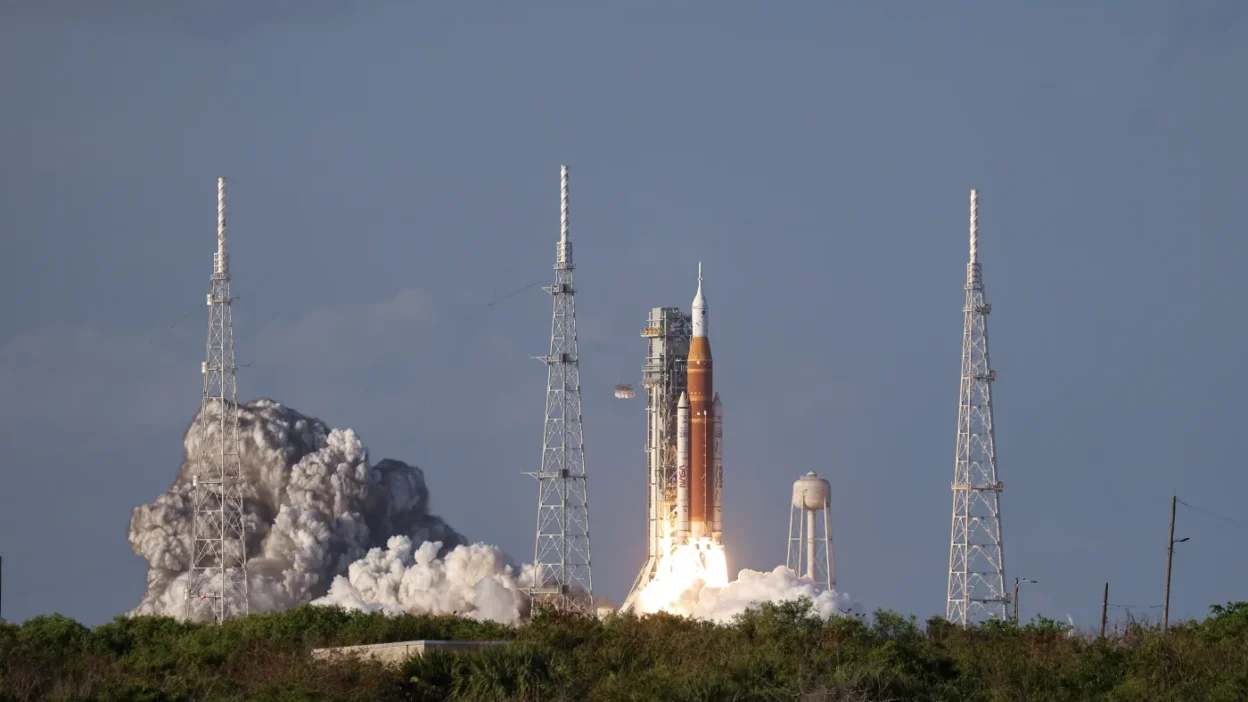
NASA’s Artemis II mission launched from Florida on Thursday, sending a four-person crew on a 10-day journey to orbit the Moon for the first time in over half a century.
Artemis II Mission Overview
The crewed Artemis II mission launched from the Kennedy Space Center in Florida, marking the first lunar mission with humans aboard in 53 years. The mission is scheduled to last 10 days, with the spacecraft approaching the Moon at its closest point on the sixth day.
The launch, originally planned for 18:24 local time (00:24 CET), experienced a 10-minute delay. Approximately eight minutes after liftoff, the SLS rocket and Orion spacecraft, carrying the crew, reached space. The first and second stages separated after the first stage engines were shut down.
Crew Composition
The Artemis II crew consists of NASA astronauts Reid Wiseman (commander), Victor Glover (pilot), and Christina Koch (mission specialist), along with Canadian Space Agency (CSA) astronaut Jeremy Hansen (mission specialist). Koch is the first woman, Glover the first African American, and Hansen the first Canadian to travel to lunar orbit.
Historical Context
The last crewed missions to reach the Moon were in 1972 with Apollo 17. Since then, no humans have landed on the lunar surface or even orbited it; subsequent lunar missions have been uncrewed.
Previous and Future Missions
In November 2022, the Artemis 1 mission successfully orbited the Moon and returned to Earth without a crew. Originally, Artemis III was intended to land humans on the Moon, but NASA has revised plans for the 2027 mission to focus on testing integrated systems and operational capabilities in Earth orbit. A lunar landing is now planned for Artemis IV in 2028.
Day-by-Day Mission Timeline
NASA has detailed the Artemis II mission’s timeline, day by day.
Day 1: Initial Orbit and Systems Check
After main engine cutoff, the capsule and cryogenic propulsion stage (ICPS) separate from the SLS rocket. Approximately 49 minutes after launch, the ICPS engine will fire to propel the spacecraft into a high Earth orbit. The crew will spend around 23 hours checking Orion’s systems, including the water supply, toilets, and carbon dioxide removal system. Astronauts will remove their launch suits for more comfortable clothing.
The ICPS will detach from Orion, heading towards Earth and impacting the Pacific Ocean. After approximately 8.5 hours in space, the astronauts will have a four-hour sleep period, followed by Orion engine firing to position the spacecraft for the trans-lunar injection (TLI) burn, propelling it towards the Moon. The crew will conduct emergency communication checks via the Deep Space Network and sleep for another 4.5 hours.
Day 2: Exercise and Lunar Trajectory
Wiseman and Glover will begin the day with 30 minutes of exercise, with Koch and Hansen following suit in the afternoon. The crew, still in high Earth orbit, will test the life support systems. Koch will then fire the Orion service module engine to perform the TLI burn, placing the spacecraft on a trajectory towards the Moon and a free-return path – the trajectory Orion will follow to return to Earth after orbiting the Moon. The day will conclude with acclimation to space and video communication with Earth.
Day 3: Trajectory Correction and Medical Checks
Hansen will briefly fire Orion’s engines for the first of three trajectory correction maneuvers. Glover, Koch, and Hansen will practice cardiopulmonary resuscitation procedures, while Wiseman and Glover will check the medical kit. Koch will again test the emergency communication system with the Deep Space Network.
Day 4: Photography and Trajectory Adjustment
The trajectory will be corrected again. The astronauts will review targets for photography on the lunar surface during the sixth day of the flight. For approximately 20 minutes, the crew will photograph celestial bodies from the Orion windows.
Day 5: Entering Lunar Sphere of Influence
Orion will enter the Moon’s sphere of influence, where the Moon’s gravitational force becomes stronger than Earth’s. The crew will test their spacesuits. In the afternoon, the final trajectory correction maneuver before the lunar flyby will occur.
Day 6: Closest Approach to the Moon
Artemis II will approach the Moon at its closest point during the mission – between approximately 6,400 km and 9,600 km. The astronauts will spend most of the day taking photos and videos of the Moon and recording observations.
Day 7: Departing Lunar Influence and Earth-Bound Trajectory
Orion will leave the Moon’s sphere of influence in the morning. The crew will connect with Earth to discuss their observations with scientists. In the afternoon, the Orion engine will fire again to correct the trajectory towards Earth. The remainder of the day will be dedicated to extended rest.
Day 8: Radiation Procedures and Manual Control Tests
The astronauts will practice procedures for strong cosmic radiation, such as from solar flares, and will test manual piloting capabilities of Orion at the end of the day.
Day 9: Return Procedures and Waste Management
The crew will rehearse return and landing procedures and communicate with mission control. After another trajectory correction, the astronauts will test waste management systems, including the toilet. They will don compression suits to mitigate the effects of re-entry.
Day 10: Final Preparations and Splashdown
The crew will perform final trajectory corrections and restore the cabin to its pre-launch state. Equipment will be stowed, and seats reinstalled. The astronauts will don their spacesuits. The service module will detach from the crew module, exposing the heat shield. During atmospheric re-entry, the heat shield will be jettisoned, and parachutes will deploy, slowing the capsule from approximately 560 km/h to 25 km/h. Orion is scheduled to splashdown in the Pacific Ocean off the coast of San Diego, California, where NASA and U.S. Navy teams will await the astronauts.