






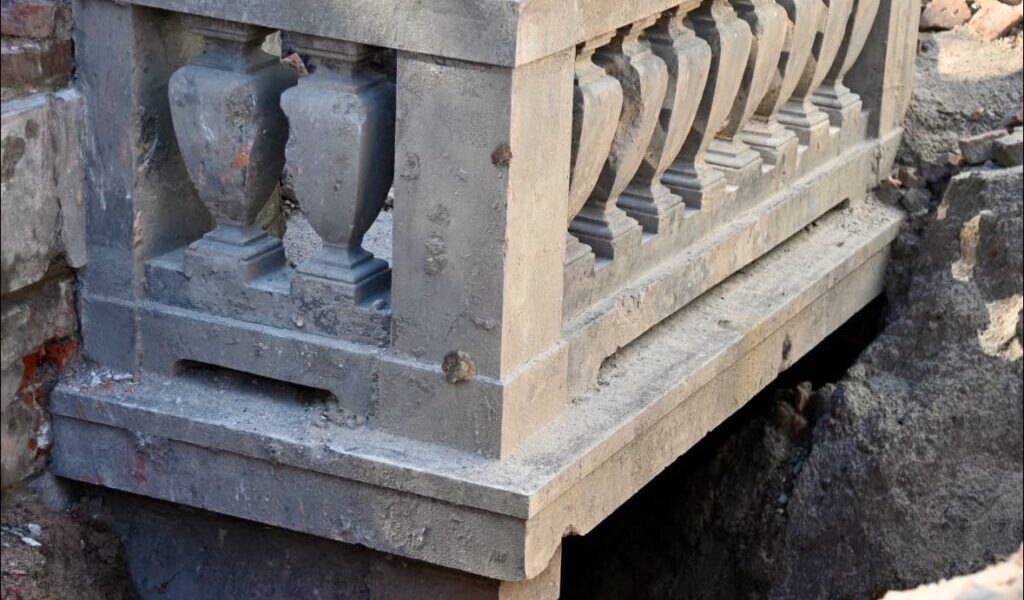
Renovation Work Unearths Hidden Fragment of Pre-War Warsaw Beneath Nowy Zjazd Slip Road
Ongoing roadworks at the foot of Warsaw’s Mariensztat have unexpectedly revealed a historic apartment building façade and balcony, which authorities have confirmed will be excavated and...
Ongoing roadworks at the foot of Warsaw’s Mariensztat have unexpectedly revealed a historic apartment building façade and balcony, which authorities have confirmed will be excavated and secured.
Table Of Content
Unexpected Discovery During Slip Road Renovations
The ongoing renovation of the slip road near Nowy Zjazd has brought to light an unexpected historical find. According to the Mazovian Voivodeship Conservator of Monuments, works conducted at the foot of Mariensztat exposed a fragment of a former tenement house façade along with a balcony. It has already been confirmed that the discovered element will be excavated and secured.
The work is taking place in an area whose history extends far back beyond the current road layout. In 1762, Eustachy and Maria Potocki established the jurydyka of Mariensztat here—a private town named after the female owner and derived from the German “Marienstadt,” meaning Mary’s town. The development was dense, irregular, and largely wooden.
Trade, Crafts, and 19th-Century Transformation
Trade played an important role in the life of old Mariensztat, with large fairs organized three times a year and Tuesday markets held on a square commonly known as “Maryniak.” Craftsmanship also flourished in the neighborhood, with coopers making barrels used for transporting beer and other goods floated down the Vistula, a history reflected in the name of today’s Bednarska Street. Mariensztat lost its status as a separate jurydyka during the reforms of the Four-Year Sejm.
Another major change was brought by the 19th century. Between 1844 and 1846, designed by Feliks Pancer, Nowy Zjazd was built leading from the Castle Square area towards the Vistula, complete with a monumental masonry viaduct. Initially, it led to the existing river crossing, and from 1864 it connected to the new steel Kierbedź Bridge, construction of which began in 1859.
The Rise and Fall of Multi-Story Tenements
This new transport connection influenced the development of the area. Multi-story tenement houses began to appear near the high viaduct, one of the most characteristic being the later House of the Professors of the University of Warsaw of the “Siedziba” Housing Cooperative at Nowy Zjazd 5.
Completed in 1925 to a design by Konstanty Sylwin Jakimowicz, the building had five floors and an attic in a mansard roof. Due to the height of the viaduct, the main entrance from Nowy Zjazd led via a characteristic platform directly to the third-floor level.
The tenement was destroyed in 1944. Its external walls and platform survived in relatively good condition, but most of the wooden ceilings burned down. In 1947, an initial permit for reconstruction was issued on condition that the building be lowered by two storeys, but the reconstruction ultimately did not take place, and the remains were demolished in the second half of 1948 due to changes in the design of the W-Z Route.
Current Excavation and Ongoing Street Works
Now, during exploratory work conducted in the area, a fragment of pre-war development has surfaced once again. The Mazovian Voivodeship Conservator of Monuments reported that a part of the former tenement’s façade and its preserved balcony have been uncovered.
The Mazovian Voivodeship Conservator of Monuments stated that they remain in constant contact with the Capital City of Warsaw and confirmed that the uncovered balcony will be excavated and secured.
The published information has not yet definitively indicated which former tenement the discovered fragment belonged to. The Conservator announced that further information regarding the find will be provided as the work progresses.
The works encountering these historical remnants are linked to the renovation of the slip road at Nowy Zjazd, which the Municipal Road Authority began in early July. The project covers the road leading from Wisłostrada towards the Śląsko-Dąbrowski Bridge and Praga, and is scheduled to last until September, after which stone paving will return and sidewalks will be renewed.
The discovery of the tenement fragment demonstrates how many traces of Warsaw’s former layout survive beneath modern streets and embankments. The current work is being conducted in an area repeatedly transformed over the centuries, from the 18th-century jurydyka through the construction of Nowy Zjazd and tenement houses to the post-war building of the W-Z Route.