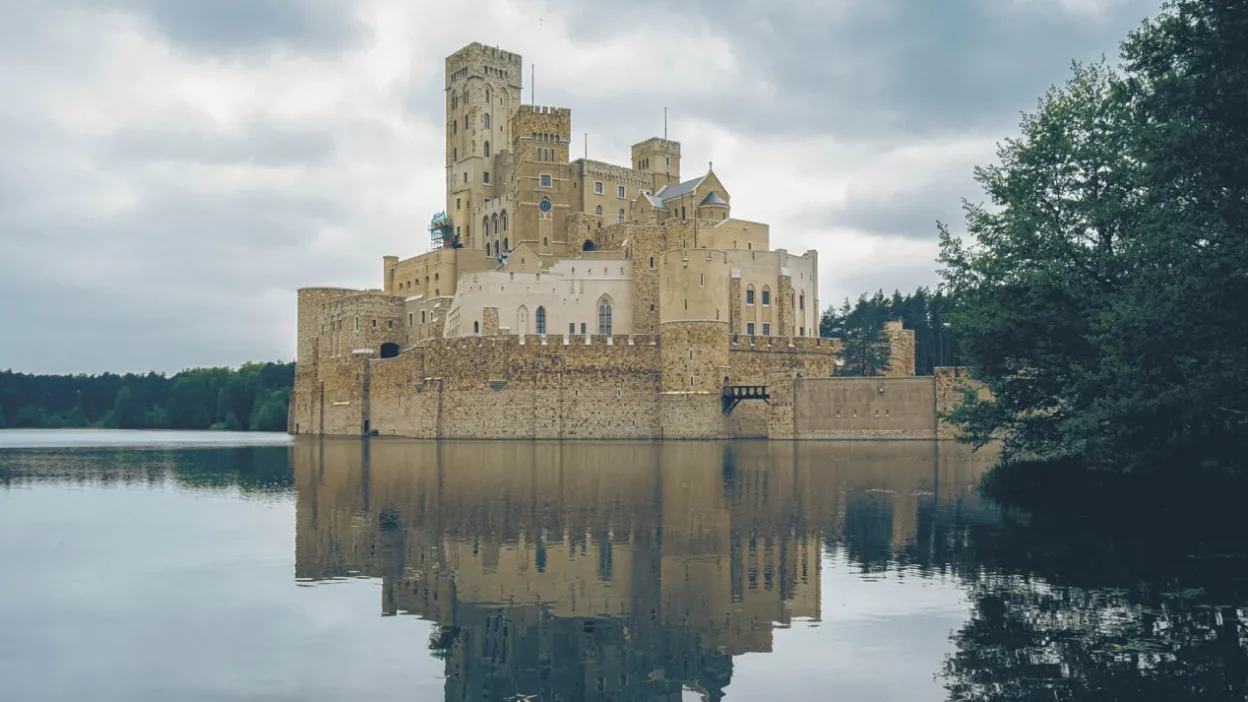
Poland’s Supreme Administrative Court definitively dismissed an environmental agency’s appeal regarding the construction of a medieval-style building in Stobnica, Wielkopolskie Voivodeship.
Dispute Resolved: NSA Rejects GDOŚ Appeal
On Tuesday, the Supreme Administrative Court (NSA) rejected a cassation complaint filed by the General Director for Environmental Protection (GDOŚ) concerning the so-called castle in Stobnica (Obornicki County, Wielkopolskie Voivodeship). The court ruled that the building permit was issued in accordance with the law, marking a final administrative decision on the investment.
Project History and Initial Scrutiny
Construction of the multi-story structure, designed to resemble a medieval castle, began within the Natura 2000 area based on a permit granted in 2015. The investor is the Poznań-based company D.J.T. The project gained public attention in the summer of 2018, prompting an investigation by the Central Anti-Corruption Bureau (CBA) into the validity of the issued decisions. Subsequently, the Minister of the Environment instructed GDOŚ to initiate an urgent review of the decision-making process, and the case was also referred to the prosecutor’s office.
RDOŚ Reversal and Subsequent Appeals
In late April 2019, the Regional Directorate for Environmental Protection in Poznań (RDOŚ) revoked its May 2015 decision outlining the conditions for conducting the investment in Stobnica and opposed its implementation. Initially, in 2015, RDOŚ determined the construction would have no negative environmental impact and did not require an environmental decision. The Directorate reversed its decision after discovering that the area transformed for the project exceeded the investor’s previously declared approximately 1.7 hectares. RDOŚ asserted the actual construction area was over 2 hectares, necessitating an environmental impact assessment.
GDOŚ Maintains Decision, Investor Appeals
In July 2019, GDOŚ upheld the RDOŚ decision in Poznań. The investor appealed to the court. The Voivodeship Administrative Court in Warsaw, in a March 2020 ruling, overturned the GDOŚ decision. GDOŚ then filed a cassation complaint with the NSA. In March 2024, the NSA initially rejected the complaint, citing that it was filed after the statutory deadline. However, the court later acknowledged an error and resumed proceedings upon a request from a public party.
Final Ruling: NSA Dismisses GDOŚ Cassation
On Tuesday, the Supreme Administrative Court definitively dismissed GDOŚ’s cassation appeal against the 2020 ruling by the Voivodeship Administrative Court. Judge Jerzy Stelmasiak stated that improper implementation of the project by the company does not invalidate the original decision, as the increased area was determined *after* the decision was made.
Conditions for Reopening Cases
Judge Stelmasiak explained that, according to regulations, proceedings are reopened only if significant new circumstances emerge that could have led to a different outcome. He emphasized that such circumstances must have existed at the time of the final decision and were unknown to the issuing authority.
Administrative Proceedings Concluded
Aneta Fornalik, the investor’s attorney, stated to PAP that with the NSA’s ruling, all administrative proceedings regarding the construction of the so-called castle in Stobnica have been conclusively resolved. She affirmed that no decision has been overturned in a way that would halt construction, and that all decisions related to the building have been and remain legal.
Future of the Investment
Fornalik added that construction is formally still underway. When asked about the possibility of converting the building into a hotel, she stated that the investor’s plans are unknown. “We cannot predict what the investor will do. Formally, they are implementing the investment covered by the building permit,” she said.
Further NSA Rulings
In March 2025, the NSA dismissed cassation complaints regarding the construction of the so-called castle, filed by, among others, the Chief Inspector of Building Supervision, in a separate administrative matter.
Criminal Proceedings Ongoing
A criminal trial concerning irregularities during the construction of the so-called castle has been ongoing since November 2023 at the Regional Court in Oborniki (Wielkopolskie Voivodeship). Representatives of the investor and officials are among the defendants in this criminal proceeding.