Poland’s President Karol Nawrocki established a New Media Council, sparking immediate criticism over the inclusion of figures linked to disinformation and past legal issues.
President Establishes New Media Council, Faces Backlash
President Karol Nawrocki’s decision to establish the New Media Council has triggered a swift and strong reaction. The council includes individuals such as Paweł Swinarski, a content creator who published materials identified as Russian disinformation, Rafał Ziemkiewicz, a journalist convicted of defamation, and Karol Gac, a former public media commentator during the Law and Justice party’s rule.
Council’s Mandate and Criticisms
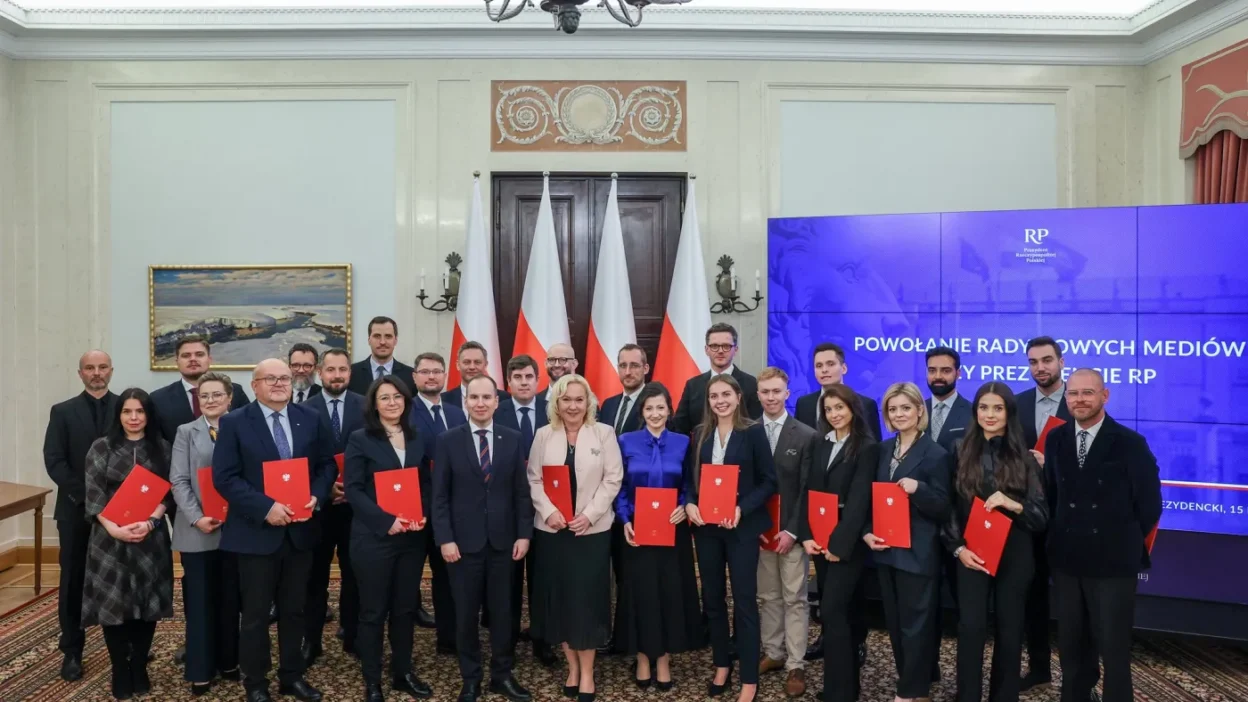
The New Media Council was officially launched on Wednesday at the Presidential Palace. According to the Presidential Chancellery, the council will assess the state of contemporary media, analyze its impact on society, and propose solutions for the functioning of the media market in the digital age.
Key tasks include developing media literacy and strengthening societal resilience to disinformation. However, the specific nominations have drawn significant criticism, given this stated goal.
Council Membership
Klaudia Cymanow-Sosin will chair the New Media Council, which comprises a total of 27 members: Klaudia Cymanow-Sosin, Angelika Badan, Magdalena Baranowska, Michał Białek, Marcin Czapliński, Łukasz Gabler, Karol Gac, Agata Górnicka, Urszula Grotyńska, Marcin Kędryna, Emil Kędzierski, Łukasz Korus, Weronika Kostrzewa, Michał Lewandowski, Eryk Mistewicz, Ewelina Nycz, Anna Pawelec, Kamila Pietrzak, Klaudia Rosińska, Mikołaj Smereczyński, Paweł Swinarski, Tomasz Trzaska, Jakub Turowski, Patryk Wachnik, Łukasz Widuliński, Mateusz Wiktorowicz, and Rafał Ziemkiewicz.
Controversial Appointments: Swinarski and Ziemkiewicz
The appointment of Paweł Swinarski, creator of the “Dla Pieniędzy” channel, has generated the most controversy. In 2025, he published a report suggesting a Ukrainian provocation was behind an incident involving Russian drones in Polish airspace in the previous September. Experts identified these claims as Russian disinformation, and the Polish Armed Forces General Staff used Swinarski’s material as an example of information manipulation; NASK also investigated the matter.
Rafał Ziemkiewicz’s appointment has also drawn criticism, as the journalist was previously convicted of defamation and his public activities have repeatedly sparked controversy. British authorities denied him entry into the United Kingdom, an event he publicly discussed on social media.
Political and Media Reactions
Politicians and journalists quickly reacted to the President’s decision. Government Spokesman Adam Szłapka stated that appointing someone linked to disinformation undermines the council’s purpose.
Journalist Patryk Michalski commented: “This is not a joke! Karol Nawrocki appointed a New Media Council, supposedly to strengthen the quality of public debate and the country’s information security. Rafał Ziemkiewicz, convicted of defamation and denied entry to Great Britain, will be responsible for this. President’s expert is Paweł Swinarski, who attacks Ukraine, spread Russian disinformation and climate misinformation according to NASK. Karol Gac, who worked for money at TVP during PiS rule, will also take care of the quality. A great disgrace.”
MEP Dariusz Joński added: “The king of fake news as an advisor to the president. Nawrocki appointed a New Media Council, which includes a man whose opinion changes depending on who pays him, and lying has become his favorite form of communication.”
Disinformation and National Security
The dispute over the council’s composition occurs within the broader context of combating disinformation, a key challenge for European countries in recent years. Poland is particularly vulnerable to information operations related to the war in Ukraine and geopolitical tensions.
Experts emphasize that disinformation concerns areas such as military security, energy policy, and international relations. In this context, the selection of individuals advising on media matters is crucial and can affect the credibility of state institutions.