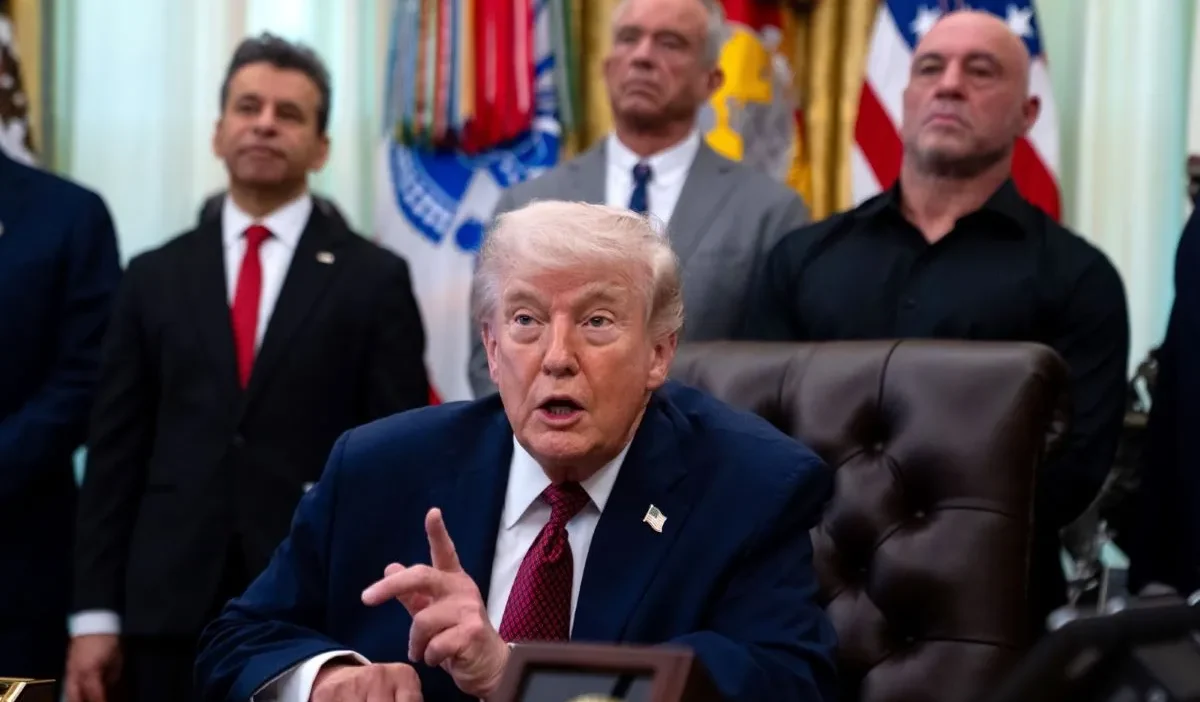
Reports detail a series of increasingly unusual actions by President Trump, prompting speculation about potential removal from office before his term ends.
A Catalog of Unconventional Acts
Observers note a pattern of behavior from President Trump that, if reported to someone unfamiliar with recent events, would seem fantastical. This includes discussing attacking Greenland, questioning NATO membership, and presenting himself in imagery reminiscent of religious figures.
Further examples include claims about influencing the Papal conclave, depicting political opponents as primates, and threatening another nation with a return to a primitive state. He also promoted personal “assets” to citizens and staged elaborate, symbolic acts.
Speculation of Impeachment and Political Upheaval
Some commentators are anticipating a potential move to remove President Trump from office following the midterm elections, predicting a possible political upheaval. Republicans, who nominated the current President, are expected to face significant challenges.
Constitutional Mechanisms for Removal
The U.S. Constitution outlines a process for presidential succession. In the event of removal, death, resignation, or inability to discharge the powers and duties of office, those powers and duties devolve upon the Vice President.
The 25th Amendment (1967) further clarifies that the Vice President becomes President if the President is removed, dies, or resigns.
The High Bar for “Removal from Office”
Removing a U.S. President requires substantial political will from the legislative branch, alongside meeting specific criteria and fulfilling numerous formal requirements. The Constitution provides several legal grounds for vacating the office.
Defining “High Crimes and Misdemeanors”
The Constitution specifies removal for “Treason, Bribery, or other high Crimes and Misdemeanors.” While bribery and treason are clear accusations, “High Crimes and Misdemeanors” encompass both criminal offenses and harmful political conduct.
However, a distinction exists between political offenses and the often-grotesque behavior exhibited by the President.
Past Impeachment Attempts
Previous impeachment attempts have been unsuccessful for Andrew Johnson (1868), Bill Clinton (1998), and Donald Trump (2019, 2021). Richard Nixon resigned amidst the Watergate scandal, rendering impeachment moot.
Incapacity and the 25th Amendment – Section 4
Section 4 of the 25th Amendment outlines a procedure initiated when the Vice President and a majority of the Cabinet (or another body designated by Congress) submit a written declaration to the Senate President pro tempore and the Speaker of the House stating the President is unable to discharge the powers and duties of office.
This process requires objective and serious impediments, not simply disagreements over public image or media behavior.
Succession Upon Declaration of Incapacity
If such a declaration is made, the Vice President immediately assumes the powers and duties of the office as Acting President. However, this is not a final transfer of power.
The President can reclaim authority by submitting a written declaration stating the disability has ceased, unless the Vice President and a majority of the Cabinet disagree, in which case Congress decides the matter.
Congressional Resolution and a Two-Thirds Vote
If Congress, within a prescribed timeframe, votes by a two-thirds majority in both houses (Senate and House of Representatives) to affirm the President’s inability to serve, the Vice President continues as President. Otherwise, the President resumes their duties.
Voluntary Resignation – A Rare Scenario
It is considered unlikely that the President would voluntarily invoke Section 3 of the 25th Amendment, submitting a written declaration of inability to serve. Such an act would be akin to Cincinnatus, who relinquished power to return to farming.