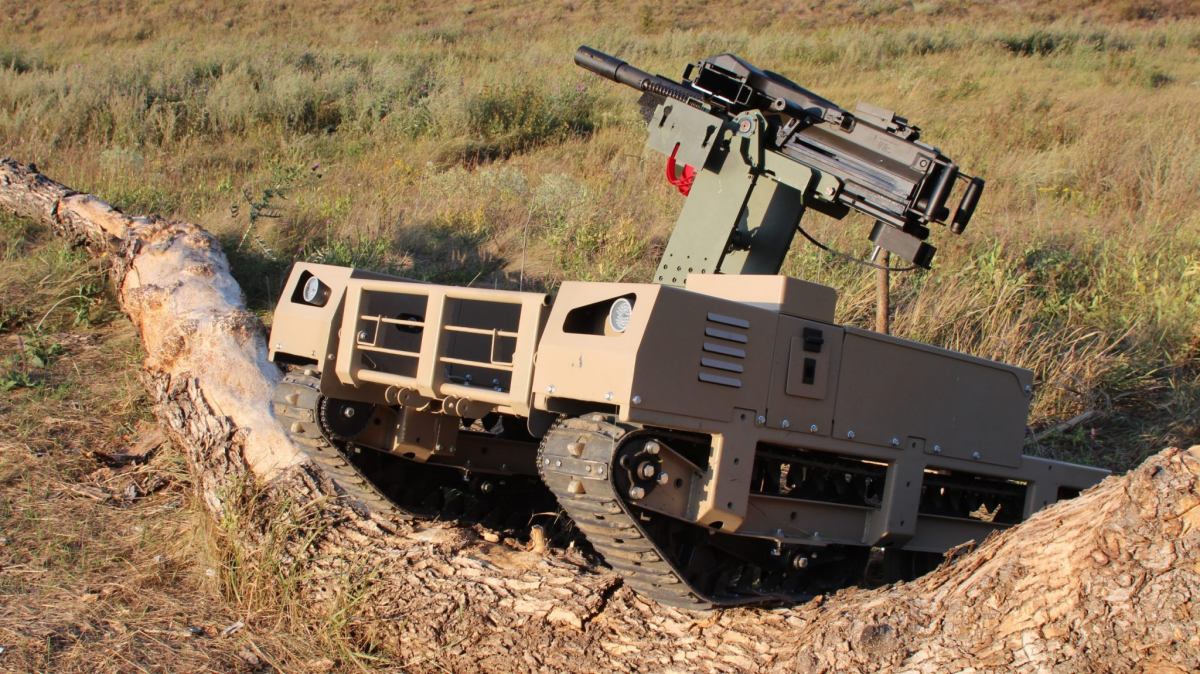
Ukraine is rapidly integrating land-based robots into its military operations, with thousands of missions completed in recent months, as highlighted by President Zelenskyy.
Land Robo-Warriors
The scale of this phenomenon is difficult to determine precisely, but it has moved beyond the experimental phase and makeshift frontline creations seen a year ago. Similar to the acceleration of aerial drone use 1-2 years prior, robotization on the ground is clearly speeding up.
Land drones are now being produced in large series, standardization is beginning, and widespread use is becoming common. Footage of their operations on the front lines is no longer novel, but rather a daily occurrence.
Zelenskyy Highlights Robotic Systems
Volodymyr Zelenskyy addressed the topic on Monday during his speech on the occasion of Gunsmith’s Day, using the opportunity to emphasize Ukrainian achievements in the production and development of weaponry, focusing on areas with the best promotional impact. This year, land drones were among those areas.
“Our land robotic systems have carried out over 22,000 missions on the front lines in the last three months. In other words, over 22,000 times, a human life has been saved when a robot went to the most dangerous zone instead of a soldier,” Zelenskyy stated. He also noted that “for the first time in the history of this war, an enemy position was taken exclusively by unmanned systems, aerial and land.”
“The occupiers surrendered, and the operation took place without the involvement of our infantry and without losses on our side,” the president added.
Increasing Mission Numbers
These figures align with recent data published by the Ukrainian General Staff. According to their reports, land drones completed over 24,400 missions from January to the end of March, with “over 9,000” in March alone – approximately 300 per day. This represents a significant increase over the 2,900 missions recorded in November.
The specific robotic assault resulting in the surrender of Russian forces referenced by Zelenskyy remains unclear. The first confirmed instances of robots being used to storm a Russian position occurred in August 2024 during an offensive in the Kursk region. A Ukrainian unit used a drone equipped with a machine gun to attack a group of Russians hiding in a grove near a minefield.
The robot was destroyed during the engagement, and it is uncertain whether its fire was accurate. However, the Russians were also shelled with mortars and eventually withdrew, allowing the Ukrainians to classify the attack as “successful.”
First Successful Capture
The 3rd Separate Assault Corps claims the first successful robot attack resulting in the capture of Russian soldiers, which occurred in July 2025. They attacked a heavily defended group of Russians with land drone-kamikazes, or self-propelled mines, known for nearly a century.
The first drone created a breach in the earthen bunker where the soldiers were sheltering. When the second entered, the Russians surrendered, unwilling to risk the detonation of another 30 kg of explosives.
Zelenskyy may have been referring to an event in the Hulaypole area in January, which resulted in compelling footage of Russian soldiers surrendering to a robot. The video shows three Russian soldiers, one wounded, and their companions looking anxiously at the sky, surrendering to a land drone, which often has speakers to deliver commands.
Drones as a Backbone of Logistics and Evacuation
While direct combat is a role for land drones, their primary function is logistics and evacuation. These are daily necessities for conducting war, which have become very dangerous due to the proliferation of aerial drones. A “zone of death” approximately 15-20 kilometers behind the contact line now makes any movement highly risky.
Supplying forward positions, rotating personnel, and evacuating the wounded are currently very difficult tasks. Initially, off-road vehicles were used, then quads with trailers became more common. Now, even these are often too large, and reaching forward positions often requires long nighttime or foggy foot journeys, which remain very risky.
The Rise of Land Drone Logistics
Drones began to be used for these tasks over a year ago, initially aerial drones, which were more numerous on the front lines. Instead of grenades, small packages of water, food, and ammunition were suspended beneath them and dropped onto their own positions. The ability of Ukrainian soldiers to hold a position for months without rotation is often due to these supply deliveries.
However, aerial drones have limited payload capacity – a maximum of a few kilograms, or tens of kilograms for the largest models. This is often insufficient to supply several people in a dugout, requiring frequent flights and increasing the risk of losing the machine and exposing the operators.
Land Drones Offer Increased Payload
Land drones are now gaining prominence. Their standard payload is typically around 250 kilograms, with batteries lasting several hours, up to eight. Communication is provided via Starlink satellite systems or traditional radio. The latter often utilizes aerial drones as relay stations to extend range, or even deployed fiber optic cables trailing behind the robot.
A single successful run by one of these machines can provide several days of supplies to a forward position, even transporting wood for building fortifications. Ukrainian soldiers estimated in early April that drones currently handle 90 percent of logistics within the last few kilometers before enemy positions.
Evacuation and Mine Laying Capabilities
Drones are also proving effective in evacuating the wounded. Traditionally, this requires exposing several other people who must assist the injured, making them more vulnerable to detection and attack. Therefore, medical evacuation is one of the situations where armored vehicles are still frequently deployed to quickly extract the wounded and withstand drone strikes.
Logistics drones offer a convenient alternative, eliminating the risk to people and valuable vehicles while being relatively resistant to attacks from aerial drones. They have sufficient space and lifting capacity for 1-2 people. After delivering supplies to the front line, they can return with evacuees, often equipped with metal shielding resembling a coffin for protection. Footage of these evacuations is becoming increasingly common.
Drones are also used to lay mines, carrying several which are deployed on command, typically standard anti-tank mines like the Tm-62. Both sides are using this method to create minefields along the front line, attempting to block potential attack routes.
Future of Robotic Warfare
Land drones are still far from the vision of science fiction films. They remain relatively simple and clumsy machines, unable to navigate difficult terrain. They must use roads or paths, as the risk of getting stuck or overturning is too high. Operator awareness and reaction time are limited by the simple camera with a frequently disrupted signal.
Their ability to avoid attacks is minimal. One soldier quoted in “The Guardian” stated that his unit loses one in four land drones sent on a logistics mission. Both sides actively hunt them with aerial drones. Despite these limitations and high loss rates, their use is growing rapidly, demonstrating that it is a significantly better solution than risking human lives, especially for the Ukrainian side, which places a high value on preserving personnel.
Further widespread use and continuous development of land drones can be expected. The variety of models available can be seen on the Ukrainian Brave1 online store, where military units can exchange points earned for combat successes for weapons and equipment. Land drones are the second largest category in the catalog, after aerial drones, with 10 pages of different models available, priced from 3.9 million hryvnias (approximately 320,000 złoty) for the largest to 100,000 hryvnias (8,200 złoty) for the smallest.