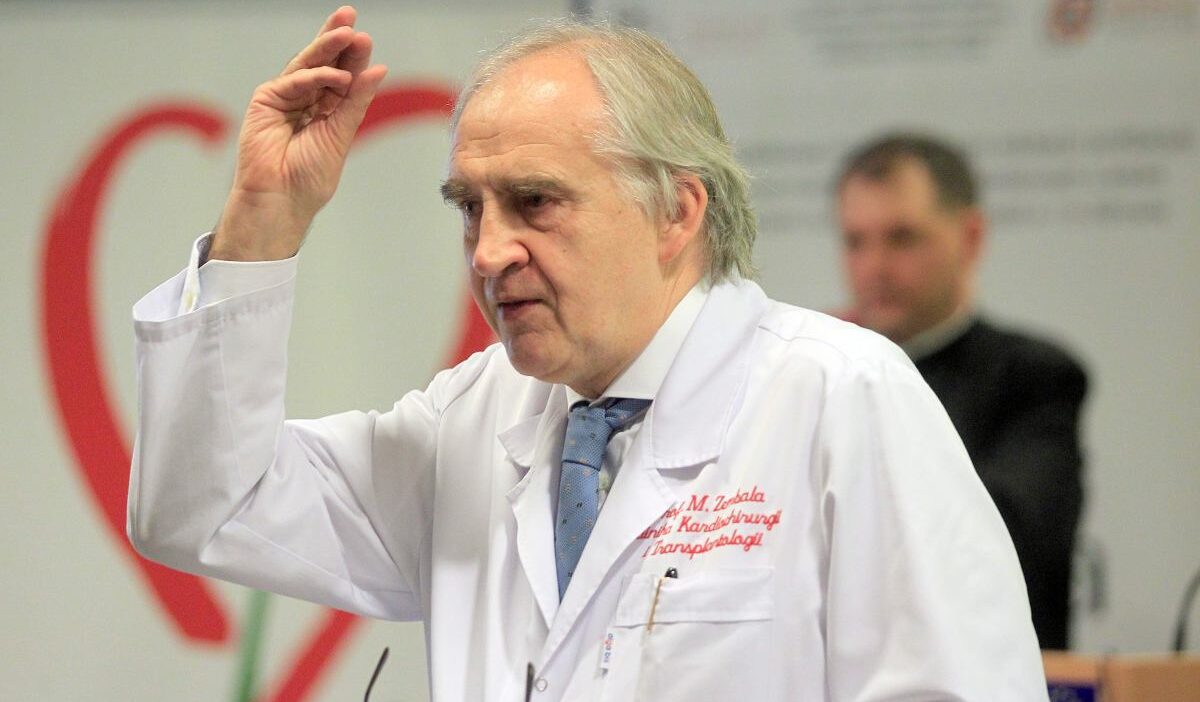
Polish cardiac surgeon Marian Zembala has occupied most of former chief Zbigniew Religa’s posts—including minister of health and seat in the Sejm—but was denied the university rectorship, according to insiders.
Ambition and Shadow
Bochenek and Cichoń noted that they accepted Religa’s greatness without aspiring to a pedestal. Zembala, unable to relinquish that ambition, felt superior to his boss because he published more in scientific journals and managed the hospital better. He built a large center yet could not escape the shadow of his predecessor, Jan Sarna remarked, “It was funny; Religa did not expect greatness from him, but he imposed that burden on himself.”
Jan Borzymowski observed how, over years, a complex toward the boss gnawed at Marian. “He wanted to take everything Religa had achieved, but it did not come to him so easily,” explained the professor.
In interviews, politicians asked Religa, “Do you want to become a member of parliament?” He replied, “I could, why not.” “What about rectorship?” He answered, “I could.” When asked about the Health Ministry, he said, “It isn’t that I want it; politics does not appeal to me,” yet he still succeeded in the field. Marian followed his steps, but, according to Jan Borzymowski, “he had to work hard for every position.” He ‘climbed’ where Religa had been, reached even the Sejm after four years of waiting, and served as minister for five months.
Academic Track Records
Prof. Lech Poloński contrasted the two men: “They were completely different. Religa was a ‘musketeer’ who acted on ideas without a detailed plan, approaching surgery as a bold experiment. Marian was calculated, ensuring every detail was planned and risks minimized. The balance favored Religa.”
Poloński noted that Marian “did nothing comparable to Religa’s first successful heart transplant; in cardiac surgery, no one could surpass Religa.” He recalled another milestone where both heart and lung were transplanted in Zabrze – a great achievement but not as monumental as Religa’s work.
The difference is evident in their treatment of students: Religa produced an innumerable number of protégés who now hold professorships and run cardiac units across Poland. Marian recorded only two habilitations – Jerzy Pacholewicz and his son Michał. Prof. Ewa Kucewicz‑Czech echoed that disparity, stating that Marian could boast only those two as his students.
Personal Characteristics
Jan Sarna reflected that after Religa’s death, the loss of that complex freed Marian: “I noticed a change in his behavior. He became freer and exuded confidence.” Though Zembala appreciated this view, hospital colleagues still see him through Religa’s lens.
Religa was described as unpretentious, wearing a battered Fiat, shorts, and unspecialized shoes. He left his family to pursue his dream profession, teaching that the patient is paramount and the fight for life can cost anything. He famously said, “When you feel sleepy, drink coffee,” and embodied authenticity. In contrast, Marian cared for patients but was less charismatic. Money mattered to him; he founded a company, lived well, kept elegant clothing, and drove a nice car, which did not match his professed values. Religa trusted in him; Marian had a different approach.
During a renovation, staff observed the gap in work ethic: “We were less busy; the HR head was busy with construction checks.” Marian allowed it; Religa would have insisted otherwise.
Romuald Cichoń said, “Prof. Religa was not the most pedantic or meticulous surgeon; he came from a different school than Marian, yet had an iron will to save patients at all costs.” He recounted the long-ago and rare surgery on his aunt’s heart in Warsaw, later repeated in Zabrze, where the surgeons fought to save her with double heart procedure – a visionary feat that Marian could not risk.
Legacy and Cultural Portrayals
After the premiere of the film “Premiera Bogów” at the Multikin Zabrze, Prof. Zembala praised the movie: “I liked the pacing, dialogue, acting, and attention to detail. The striped blanket depicted on screen is the same one used by Religa—an instant time‑travel.” He felt the film echoed his commitment to patient service.
He later sent a message to Piotr Głowacki: “Thank you for representing me so honourably on screen. – Marian.” The message was sent at 2:43 a.m.
Personal Hardship and Public Life
Bolesław Piecha, a member of parliament, noted that Zembala had visited the Sejm several times when the electric chair was still operational; it overwhelmed him psychologically. He needed to wake up to greet someone but could not forget he could no longer.
Wojciech Saucha, an anaesthesiologist, explained that post‑attack Zembala no longer had full control over what occurred in the hospital. The surrounding environment did not facilitate his oversight, isolating him to avoid seeing unintended sights and provoking quarrels. “Why? Let him sit in his own office,” said Saucha.