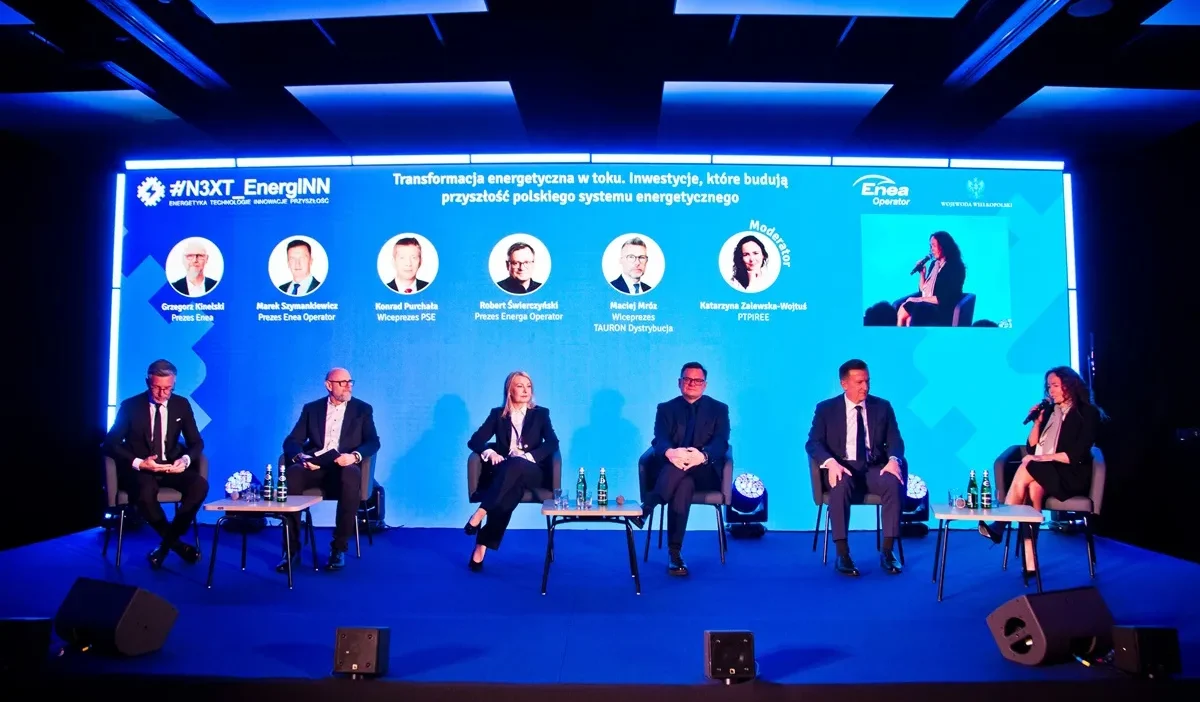
The EnergyOn Summit in Poznań convened key political and industry leaders to discuss Poland’s potential to lead Europe in energy independence and technological advancement.
Transformation as the Engine of a New Economy
During the event’s inauguration, Krzysztof Bolesta, Secretary of State at the Ministry of Climate and Environment, emphasized that the current transformation extends beyond the energy sector, becoming a key factor in modernizing Polish industry.
The ministry reports Poland is effectively building a position as a European leader in emerging technologies, evidenced by its status as the largest producer of batteries and energy storage in Europe – reinforced by a new investment in Pomerania, joining an existing center in Lower Silesia.
Geopolitics and Security of Supply: A Perspective from the MTP Group
Robert Wielicki, President of the Management Board of the MTP Group, highlighted the strategic dimension of the changes, noting that in 2026, energy transformation ceased to be viewed solely through the lens of climate protection, becoming a foundation for state security and economic stability.
In a time of global tensions, Wielicki stated, the continuity of energy supply determines the operational capacity of enterprises and their position in international markets.
A Unique Opportunity to Build New Value Chains
According to Robert Wielicki, Poland has a unique opportunity to build new value chains, with simplification of investment procedures and stimulating real demand for low-emission products being key to success.
The Poznań forum was identified as a place where the theory of transformation meets business practice, allowing for the development of solutions combining industrial modernization with hydrogen technologies.
Greater Poland Region Focuses on Renewable Energy Sources
Jacek Bogusławski, a member of the Board of the Wielkopolska Province, emphasized the regional dimension of the debates, highlighting the region’s role as a key economic driver for the country.
For Wielkopolska, the priority is the development of renewable energy sources (RES) and the creation of a system where generated energy can be directly used by local businesses, educational institutions, and households.
Energy Storage: From Financing to Grid Stability
The substantive panel discussions opened with a debate on energy storage in Poland, with experts from NFOŚiGW, Enea, and research institutes analyzing regulations and project “bankability.”
Discussions were crucial, as without appropriate financial tools, the construction of large-scale storage facilities will remain out of reach for many investors, hindering RES development.
Cybersecurity and Technologies of Tomorrow: AI, SMR, and CCS
The forum also included sessions dedicated to the digitization of critical infrastructure, with Krzysztof Malesa from Microsoft presenting an analysis of cyber warfare threats, emphasizing the need to protect IT and OT systems that underpin stable energy supplies.
Participants analyzed the evolution of threats facing system operators in 2026, while the agenda also covered a broad spectrum of technologies supporting the “Net Zero” strategy, including nuclear energy, small modular reactors, carbon capture and storage, and hydrogen.
Hydrogen Roundtable: Industry Seeking Specifics
During the H2 Poland session, the focus was on transitioning from declarations to the real-world use of hydrogen in the economy.
The “Round Table,” with representatives from Orlen S.A., Grupa Azoty, and GAZ-SYSTEM, detailed the assumptions of the EU’s RED III directive and the Industrial Accelerator Act.
Experts identified specific infrastructural and regulatory gaps that must be addressed for Polish industry to fully implement hydrogen technologies, concluding that 2026 is a critical year for building the Polish hydrogen economy, requiring close coordination between the public and private sectors.