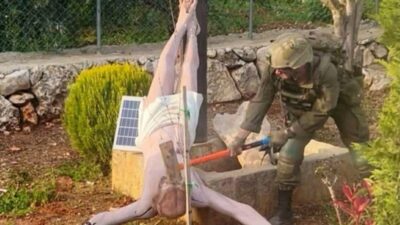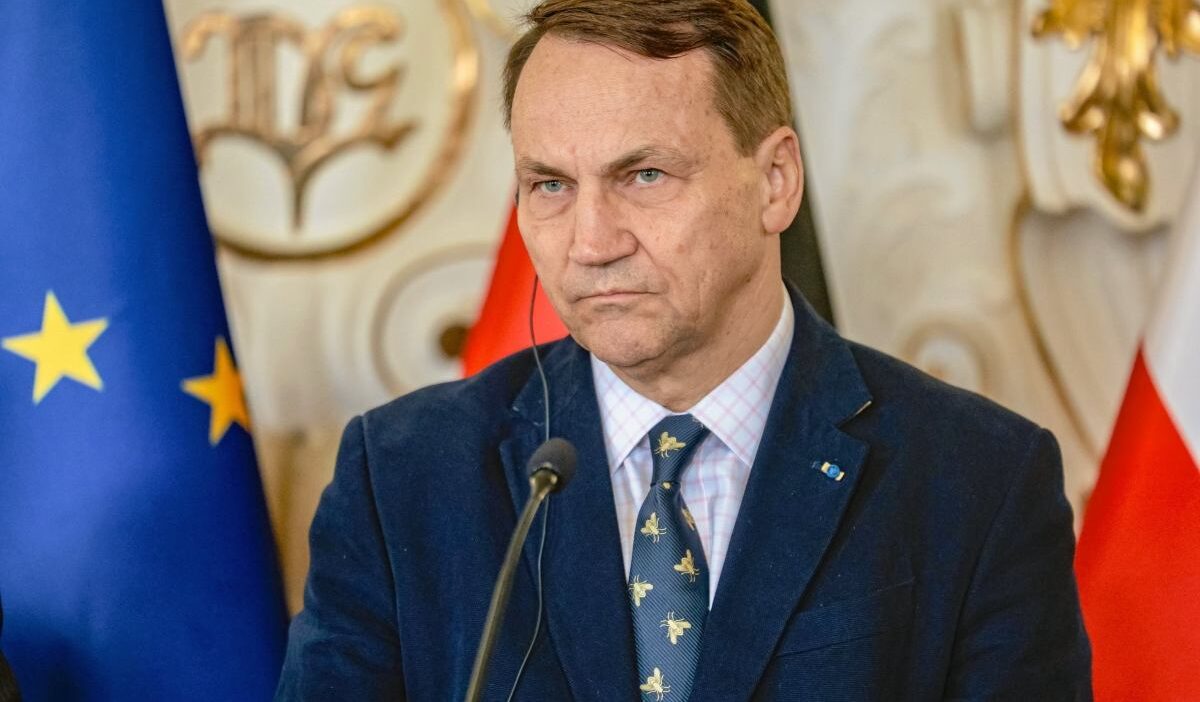
Polish Foreign Minister Radosław Sikorski and Israeli Minister Gideon Saar engaged in a public dispute following a video showing an IDF soldier destroying a religious statue in Lebanon.
Israeli Minister Condemns Soldier’s Actions
Israeli Foreign Minister Gideon Saar condemned the destruction of a Christian religious symbol by an IDF soldier in southern Lebanon as “serious and disgraceful.” He stated his appreciation for the IDF’s condemnation of the incident and the launch of an investigation.
A photograph, authenticated by the IDF, depicts a soldier smashing a figure of Jesus with a heavy hammer.
Sikorski Calls for Punishment and Training Review
Radosław Sikorski commented on the matter on X, stating, “It’s good that Minister Saar quickly apologized, there was reason to. The soldier should be punished, but lessons should also be drawn regarding the way they are trained.”
Sikorski further wrote, “IDF soldiers themselves admit to war crimes. They killed not only civilian Palestinians, but even their own hostages.”
Saar Accuses Sikorski of “Baseless and Slanderous” Claims
In response, Saar accused Sikorski of making “baseless and slanderous statements” against the Israeli army. He argued that Sikorski’s statements demonstrated “ignorance and a deep lack of understanding.”
Saar explained that in any war, operational incidents occur, including cases where armed forces suffer losses due to friendly fire, and that civilians are unfortunately harmed, especially when used as human shields by terrorists.
Israel Defends Military Precision
Saar emphasized that “there are no Western armed forces that fight terrorism more precisely, or with better intelligence, than the IDF.” He added that the Israeli army does so “while minimizing civilian casualties.”
He claimed the IDF’s ratio of terrorist to civilian casualties is better than any other Western army and any armed forces globally, describing the IDF as a professional and ethical army.
Ukraine’s Evolving Role in the Conflict
Separately, former military intelligence officer Maciej Korowaj stated that Ukraine is now offering invaluable military knowledge to the West, having become an expert in survival and disrupting the Russian war machine.
Saar Demands Sikorski Condemn Antisemitism in Poland
Saar appealed to Sikorski to personally condemn a recent antisemitic incident in the Polish parliament involving Konfederacja MP Konrad Berkowicz, who displayed an Israeli flag with a swastika.
Berkowicz received the maximum penalty from the Sejm’s presidium – half his salary for three months.
Sikorski Responds and Calls for IDF Training Changes
Sikorski responded that he condemned the antisemitic incident on the day it occurred and that the MP was disciplined by the Speaker of the Sejm. He added, “As for the rest, if this does not prompt you to introduce changes in soldier training, I cannot help you.”
He linked to an article in the Israeli newspaper “Haaretz” about Israeli soldiers struggling with issues beyond PTSD after “killing civilians in the Gaza Strip” and witnessing “abuse and brutality in the name of revenge.”
Concerns Over IDF Procedures and Civilian Casualties
Sikorski clarified he was not suggesting IDF soldiers intentionally killed Israeli hostages, but that the fact they did suggests “their procedures on the battlefield were too loose.” He noted that errors also led to the deaths of NGO workers, including Polish citizen Damian Soból.
Damian Soból was killed on April 1, 2024, in an attack on a World Central Kitchen convoy in Gaza. The IDF struck the humanitarian convoy delivering food in Deir al-Balah, killing seven volunteers. World Central Kitchen suspended operations in the region following the attack, and the Przemyśl prosecutor’s office launched an investigation into Soból’s death.
Lebanese Context of the Incident
Israel took control of several areas in southern Lebanon, a Hezbollah stronghold, after the Iran-backed group attacked Israel on March 2, following Israeli-American bombings of Iran. A ceasefire came into effect in Lebanon on Friday. The figure of Jesus was located in the Christian village of Debl, in southern Lebanon, near the border with Israel.