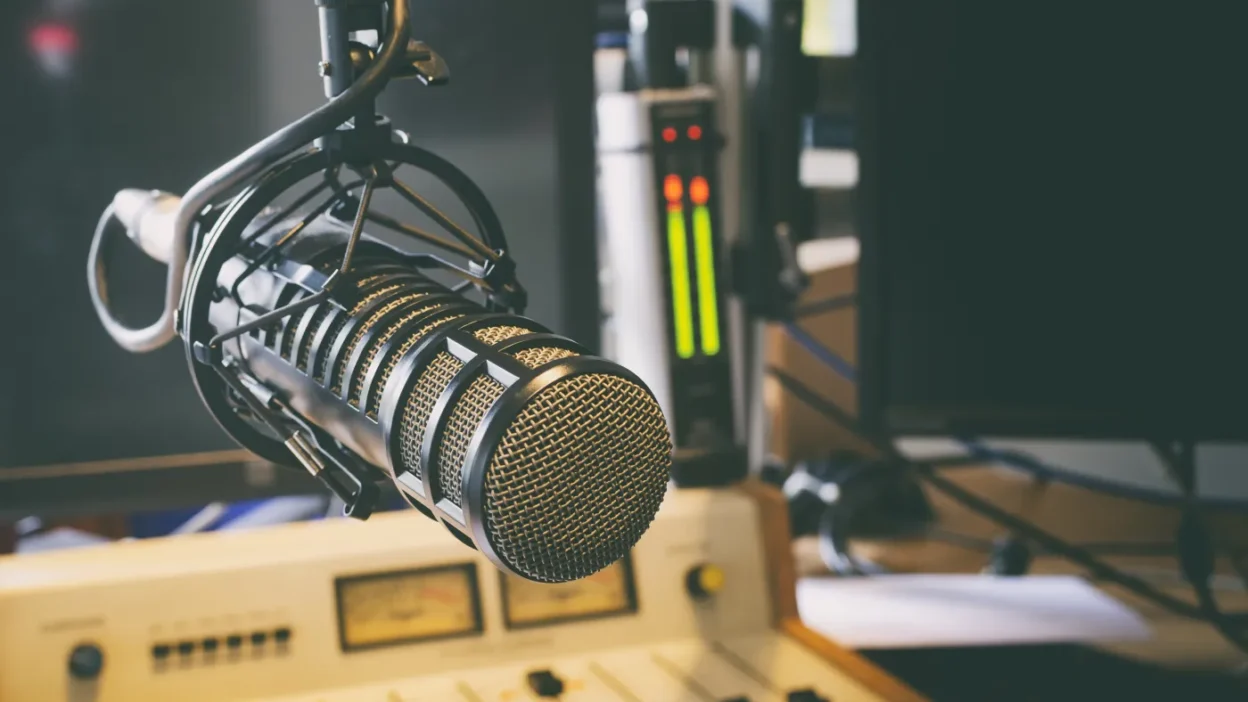
Polish Radio marked its centennial on April 18, 2026, with special programs and concerts commemorating a century of broadcasting history.
A Century of Airwaves
On April 18, 1926, Polish Radio began regular program transmission, initially at 5:00 PM. The anniversary is being celebrated with numerous special broadcasts and concerts.
Radio One’s Centennial Celebrations
Radio One is commemorating its 100th birthday on April 18th. Roman Czejarek will remain in Warsaw for the occasion, hosting “Jedyne takie miejsce,” a program exploring the Polish Radio headquarters with Patryk Bedliński from 9:00 AM to 12:00 PM.
The program will offer listeners a tour of the building on Malczewskiego Street, revealing the secrets of the studios where Radio One’s programs are created.
“A Century of Radio” Concert
A musical spectacle, “Wiek radia,” will begin at 5:00 PM in the Lutosławski Concert Studio of Polish Radio, precisely 100 years after the first broadcast. The artistic direction is by Łukasz L.U.C. Rostkowski.
Performers include Krystyna Prońko, Natalia Kukulska, Ania Rusowicz, Paktofonika, Krzysztof Cugowski, the Polish Radio Orchestra, and Rebel Babel Ensemble. The concert will be broadcast live on Radio One.
Teatr Polskiego Radia Presents “Jazda”
Following the concert, at 9:00 PM, Radio One will present “Jazda,” a play written by Martyną Wawrzyniak specifically for the station’s centennial, directed by Julia Mark.
Memories of Early Radio
– My fascination with radio began in 1927 when, as a poor student, I bought a very weak crystal radio. I was incredibly happy when I managed to hear something in the headphones. At Zielna 25 – where the Polish Radio building was located from 1929 – there were two studios. One of them housed a Steinway piano. That’s where I played – recalled pianist and Polish Radio legend Władysław Szpilman.
He continued, – I came to work every day, doing everything, mainly accompaniments.
Radio’s Unique Sensitivity
– My colleagues and I often discuss why radio is such an integral part of our artistic lives, so close, incomparably different from work. Radio represents a completely different plane of sensitivity [than film or television]. It offers the possibility that a person who returns home tired after a day of noise, clatter, and movement, sits down in the evening, turns the speaker knob – and is suddenly transported to another world. A world that appeals to their imagination – reminisced Kazimierz Rudzki (1911-1976), an actor, director, and educator closely associated with Polish Radio.
A Gift from a Gas Station Attendant
– My greatest radio satisfaction came during the gas rationing period when I drove to a station in my first car, a “maluch.” The attendant approached me and said, “Do you know what? I won’t take your ration card; it’s a gift from me.” I asked why. Because when you report matches on the radio, my father regains his sight – recalled Dariusz Szpakowski, an icon of Polish sports journalism.
Jeremi Przybora’s Connection to Radio
Jeremi Przybora, a poet, satirist, and co-creator of the Kabaret Starszych Panów, but also a radio personality, stated simply: – I was born from the radio and will return to the radio.
Polish Radio as a Witness to History
Polish Radio has been a witness to historical events since its inception. On September 1, 1939, announcer Józef Małgorzewski announced the German attack: “So, war! From today, all matters and issues take a back seat. Our entire public and private life is being put on a special track – we have entered a period of war. All the nation’s efforts must go in one direction. We are all soldiers. We must only think about one thing – fighting until victory.”
This message was actually recorded on August 29th by Małgorzewski and broadcast on September 1st by Zbigniew Świętochowski.
Iconic Sports Commentary
– Oh, shoot, faster, he shoots… it’s in! – These legendary words describing Lucjan Brychczy’s goal during Legia Warsaw’s match against Slovan Bratislava in 1956 became the signal for “Kronika sportowa.”
“He accelerates, goes up… he cleared it! He cleared it!” – legendary commentator Bohdan Tomaszewski exclaimed about Władysław Kozakiewicz’s pole vault jump at the 1980 Moscow Olympics, winning a gold medal. Other words by Tomaszewski also became part of Polish sports journalism history. “Halooo, here’s Wimbledon!” – was his signature opening for broadcasts from the famous tennis tournament.
A Century of Impact
As stated in a parliamentary resolution, Polish Radio has captured the imagination of millions of listeners, becoming an important broadcaster of publicistic, historical, sports, cultural content, and promoting music. For a century, it has been “a witness to events, a medium reacting to current affairs. It informed, entertained, and played an extremely important role in educating, raising, and shaping the tastes of many generations.” For many listeners, it remains “a window to the world, a theater of imagination, an auditory magician, a unique source of emotions.”
Early Beginnings and First Broadcasts
The history of Polish Radio dates back to April 11, 1923, when the Polish Radio Technicians Association adopted a document containing opinions on guidelines for the radio telegraph law. The first experimental radio broadcast from the station of the Polish Radio Technology Company in Warsaw was transmitted on February 1, 1925, at 6:00 PM, when engineer Roman Rudniewski said: “Here is the experimental radio station PTR in Warsaw, wave 385 meters.”
Chopin’s Debut
In the first broadcast, Poles heard Fryderyk Chopin.
Official Launch and First Words
The Warsaw Polish Radio station officially began operations a year later, on April 18, 1926, at 5:00 PM. “Halo, halo, Polish Radio Warsaw, wave 480” – these words preceded the first official broadcast, which featured music by Fryderyk Chopin. They were spoken by 23-year-old announcer Janina Sztompkówna, sitting in a studio draped with curtains on the first floor of the Credit Land Society building on Kredytowa Street, the radio’s first headquarters.
The company Polskie Radio, founded in 1925, thus began its regular program activity.
Expansion to Regional Stations
The first regional Polish Radio station was launched in Krakow on February 15, 1927, and two months later, program transmission began in Poznań. On February 28, 1929, the first broadcast for foreign audiences – “Francuska skrzynka z Katowic” – was transmitted from Katowice.
Vilnius and Lviv Join the Network
Radio in Vilnius began program operations on January 15, 1928. The station soon became known for its interesting radio dramas, programs popularizing science, and popular entertainment programs throughout the country, such as “Wileńska kukułka.” On January 15, 1930, Polish Radio Lviv began broadcasting. The satirical broadcast “Wesoła lwowska fala,” hosted by the legendary duo of Lviv bachelors Szczepcio and Tońcio, was a phenomenon on a national scale.
Early Listenership and Programming
When Polish Radio began operations in 1926, fewer than 5,000 people listened to its broadcasts. The entire program was broadcast live, mainly in the evening. Music occupied most of the airtime. However, the interwar period saw intensive radiofication of the country. 1935 was a breakthrough year, with the introduction of many technical innovations, including sound recording on steel tape. There was also the possibility of broadcasting concerts or sports competitions from various locations around the world.
Diverse Programming in the Interwar Period
In the 1920s and 30s, radio broadcast lectures, programs for children, agricultural, economic, and meteorological information. The program was also enriched with literary broadcasts and radio dramas. Recording broadcasts, previously broadcast only live, became the norm.
“Podwieczorek przy mikrofonie” – A Beloved Tradition
The history of the pre-war period also includes the popular broadcast with audience participation, “Podwieczorek przy mikrofonie,” which was broadcast from the Bristol Hotel from 1936. The legendary program was revived after the occupation. Tadeusz Bocheński greeted Warsaw residents in the former Wedel chocolate shop on Marszałkowska Avenue, and the capital’s residents listened with emotion to “Piosenka o mojej Warszawie” performed by Mieczysław Fogg. “Podwieczorek” returned to the air in 1958 and was broadcast until 1989.
Polish Radio During WWII
The role of Polish Radio in September 1939 was invaluable. The capital’s population learned about the situation in the city and the progress of the fighting through the radio. The radio announced air raid alarms, speeches by President Stefan Starzyński, who encouraged his compatriots and later outlined visions of a great capital after the war, and also broadcast news from around the world. Thanks to it, information also reached beyond the front lines, including to countries occupied by Germany.
Final Broadcasts Before the Fall of Warsaw
On September 23, the Warsaw Polish Radio station ceased operations. Before that happened, radio listeners could hear a concert of compositions by Fryderyk Chopin performed by Władysław Szpilman. Until the end of September, radio broadcasters transmitted messages using shortwave radios. Thanks to this, Poles knew that the capital and Hel were still heroically defending themselves.
The Last Message of Defiance
On September 30, on shortwave, using emergency power, announcer Józef Małgorzewski read the message: “Halo, halo, can you hear us? This is our last message. Today, German troops entered Warsaw. Brotherly greetings to the Polish soldiers fighting on the Hel Peninsula and all those fighting wherever they may be. Poland is not yet lost! Long live Poland!” The same message was read in English by Jeremi Przybora and in French by Maria Stpiczyńska.
After that, the anthem was played, which was the last voice of Warsaw fighting in 1939. Shortly thereafter, the Germans entered the radio building. After taking over the station, they ordered the confiscation of receivers and forbade Poles from listening to the radio under threat of death. On October 1, Polish Radio went underground.
The “Błyskawica” Broadcast During the Warsaw Uprising
Several years of silence in the air were broken on August 8, 1944, by the “Błyskawica” broadcasting station of the Home Army. Thanks to it, the world learned about the course of the Warsaw Uprising, the plight of the capital’s population, the brutality of the Germans, and the destruction of the city. The program consisted of broadcasts prepared by the former Polish Radio team and by the Information and Propaganda Bureau of the Home Army. The last broadcast was made in the evening of October 4, after the fall of the uprising. The radio station was then destroyed to prevent it from falling into the hands of the occupier.
Post-War Revival and Expansion
In February 1945, Polish Radio resumed broadcasting from Warsaw. By 1949, there were already two nationwide programs. In March 1958, listeners received another one – Program 3, initially available only in Warsaw, and from 1962 throughout Poland. In early 1966, Polish Radio began broadcasting night programs, and in 1973, 24-hour programs. In January 1976, Program 4, a station of an educational nature, appeared on the air.
“Kronika sportowa” – A Long-Running Tradition
The longest continuously broadcast program is “Kronika sportowa.” The popular program has accompanied listeners daily for over 70 years, since its first edition on November 30, 1954.
Radio in the PRL Era
During the PRL years, the authorities used this medium as a tool for widespread indoctrination. However, for the average Pole, radio was a channel for information about events in the country and the world, about the weather, and about sports results. It also provided entertainment in the form of music and cyclical cultural programs.
Teatr Polskiego Radia – A Legacy of Drama
The Teatr Polskiego Radia is responsible for the production and broadcasting of radio dramas based on original scripts and adaptations of stage plays, novels, reportages, and poetry. The first radio drama was fragments of Stanisław Wyspiański’s “Warszawianka” in a radio adaptation and directed by Mikołaj Alojzy Kaszyn, which was broadcast on November 29, 1925. The premiere of the first play specifically written for the radio, Witold Hulewicz’s “Pogrzeb Kiejstuta,” took place on May 15, 1928, at the PR station in Vilnius.
The Art of Radio Drama
– I love the form that is radio theater, although there are no applause and bravos from the audience. Both Television Theater and Radio Theater are wonderful, original positions of Polish culture – recalled actor Marian Opania.
“Matysiakowie” and “W Jezioranach” – Enduring Favorites
The Teatr Polskiego Radia creates the largest selection of contemporary drama and classics performed by the most outstanding Polish artists. The oldest and longest-running Polish radio drama is “Matysiakowie” – it has accompanied Poles since December 15, 1956. It first aired on Program 2. PR, then was moved to Program 1. The script was written by writer and playwright Jerzy Janicki (1928–2007), who set the action in a tenement house at 21 Dobra Street in Warsaw’s Powiśle district, near his own home.
In 1960, as a rural counterpart to “Matysiakowie,” the radio novel “W Jezioranach” was created. From the beginning, it was maintained in the vérité convention – a drama as close to reality as possible, which forced the creators to maintain the three unities: place, time, and action. It was a 30-minute visit to a world created by the program’s team. In the beginning, many people even believed that the Matysiak and Jabłoński families (the main characters of the novel “W Jezioranach”) actually existed. Both dramas are still broadcast today.
Leadership at the Teatr Polskiego Radia
Janusz Kukuła was the long-term director and chief director of the Teatr Polskiego Radia from 1992–2006 and 2009–2024. Since 2024, Adam Wojtyszko has been the head of the radio theater scene.
“Lato z Radiem” and Iconic Programs
On July 1, 1971, “Lato z Radiem” was broadcast for the first time. The program was fortunate to have outstanding journalists who created the history of Polish Radio – including Tadeusz Sznuk, Andrzej Matul, Sławomir Szof, and Krystyna Czubówna. Other iconic programs include “Podwieczorek przy mikrofonie,” “Sygnały dnia,” “Lista przebojów Trójki” (whose originator and host for most editions was Marek Niedźwiecki), “Radiokurier,” “60 minut na godzinę,” “Rewia piosenek,” “Kronika sportowa,” and sports “Studio S-13.”
Jazz and Unique Voices
Since 1970, saxophonist Jan Ptaszyn Wróblewski has introduced jazz secrets to fans in the program “Trzy kwadranse jazzu.” Journalist Piotr Kaczkowski hosted the author’s program “Minimax, czyli minimum słów, maksimum muzyki,” known for his voice, but not necessarily his face. – I do not believe that showing myself, or interviews, or photographs will improve my programs – he explained.
Tomasz Beksiński’s Farewell
In the 1980s and 90s, Tomasz Beksiński hosted “Wieczór płytowy.” His farewell to fans remains moving and emotional. – The indicators relentlessly measure time. Less than three weeks remain until the conventional end of the century and millennium. Do you realize that we are meeting for the last time in the 90s of the twentieth century? And it may be our last meeting, who knows what will happen… – he said in his last broadcast “Trójka pod księżycem” on the night of December 11-12, 1999, December 24. Less than two weeks later, Beksiński committed suicide.
Marek Gaszyński – A Radio Legend
Marek Gaszyński, a journalist and music presenter, and author of the lyrics to over 150 songs, was also a legend of Polish Radio.
The Polish Radio Archives
The Polish Radio Archives collects recordings from various periods of the radio’s activity: sheet music, books, multimedia materials, and documentation. The oldest recordings date back to the first decade of the 20th century, including: trial recordings of Leo Tolstoy recorded on Edison machine cylinders, a recording of Ludwik Zamenhof from the Esperanto Congress in Barcelona in 1909, and an interview with Franciszek Żwirk after his success in the Challenge races.
The collections of the radio library, including the Nutoteka containing manuscripts by outstanding composers, are also valuable.
Polish Radio Today
Currently, Polish Radio is the largest public radio broadcaster in Poland. It broadcasts original music programs, publicistic programs, popular science, educational, social, entertainment, family, religious programs, as well as radio dramas and reportages.
National and Digital Channels
The nationwide antennas are Program 1 of Polish Radio, Program 2 of Polish Radio, Program 3 of Polish Radio, Polskie Radio 24, and Polskie Radio for Foreign Countries, and through the internet, applications, and DAB+ system, also broadcast: Czwórka Polskie Radio, Polskie Radio Dzieciom, Polskie Radio Chopin, Polskie Radio Kierowców, and Polskie Radio for Ukraine.
Online Presence and Podcasts
The polskieradio.pl portal publishes the most important news from Poland and the world every day and provides special reports, archival materials, and multimedia. Podcasts dedicated to various topics and issues, hosted by, among others, Roman Czejarek, Renata Grochal, and brothers Zygmunt and Wojciech Miłoszewscy, are one of the elements of this year’s jubilee of PR.